When people think about agriculture, they usually picture tractors moving through fields, crops growing under the sun, and farmers working long hours outdoors. What often goes unnoticed is the quieter side of farming; the decisions made every single day behind the scenes. Decisions about what to plant, how much to invest, when to irrigate, how much fertilizer to use, and whether the season will actually be profitable.
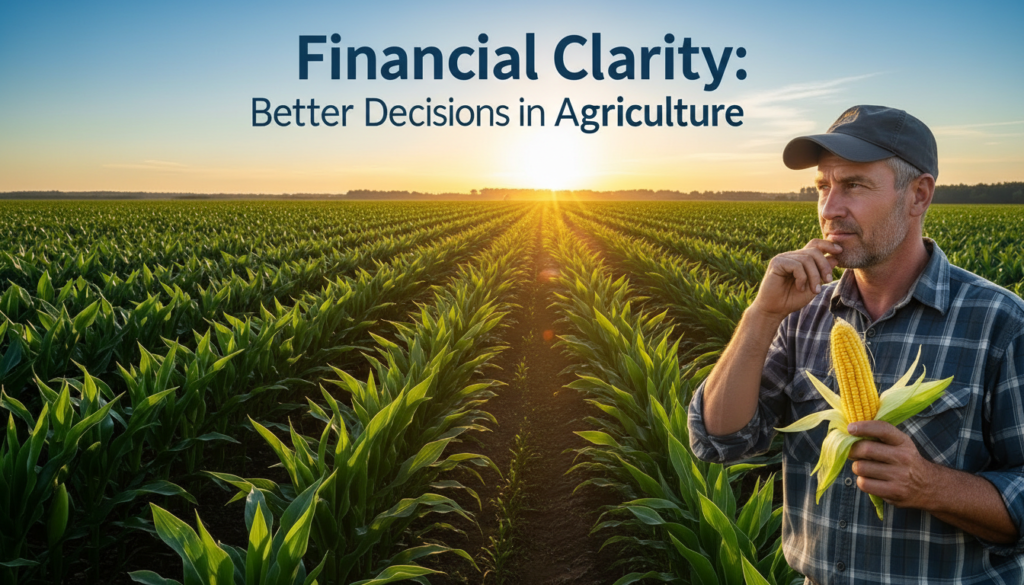
Farming may begin with soil and seeds, but it survives on numbers. Every choice a farmer makes has a financial consequence. The cost of inputs, the timing of operations, the yield at harvest, and the price at market all determine whether a season ends in profit or loss. Yet many farms still operate without clear financial visibility. Records are kept on paper, receipts are stored in drawers, and expenses are often remembered rather than tracked. Over time, this creates uncertainty, and uncertainty makes good decisions much harder. Without financial clarity, even experienced farmers are forced to rely on guesswork.
It becomes difficult to answer simple but important questions. Which crop actually earned more last year? Did irrigation reduce costs or increase the electricity bill? Are fertilizer expenses improving yields enough to justify the investment? When these answers aren’t clear, planning the next season feels like rolling the dice instead of making an informed strategy. This is where financial clarity changes everything. Clarity doesn’t mean complicated accounting or complex spreadsheets. It simply means knowing, with confidence, what you spent, what you earned, and why. With proper cost tracking, investments are made with purpose, waste is easier to identify, and profitable crops stand out clearly. Instead of reacting to problems, farmers can plan ahead with confidence.
In many ways, agriculture today is no different from any other business. Retail stores track inventory. Manufacturers monitor production costs. Logistics companies analyze efficiency. These industries rely heavily on data because they understand that visibility leads to control. Modern agriculture deserves the same advantage. After all, it is not just a lifestyle or tradition it is a business that supports families, communities, and entire economies.
Modern agriculture faces increasing pressure from rising input costs, unpredictable weather, and tight profit margins. In this environment, even small inefficiencies can have a large impact. A few untracked expenses or miscalculated investments can quietly reduce profits over an entire season. But when finances are organized and transparent, even small improvements can create meaningful results. A slight reduction in waste, better crop planning, or smarter resource allocation can significantly improve overall performance.
At Agrosenix, we believe clarity in farm management shouldn’t be hard to achieve. Farmers shouldn’t need complex enterprise software or hours of paperwork just to understand their own operations. That’s why we’re building practical, easy-to-use tools that make farm management simple, intuitive, and accessible to everyone.
Our approach starts with helping farmers digitize their everyday activities, recording fields, tracking crops, logging expenses, and monitoring performance in one place. When everything is organized digitally, patterns begin to appear naturally. Farmers can compare seasons, measure outcomes, and understand exactly where their money is going. Over time, this information becomes more than just records. It becomes insight. And insight leads directly to smarter farming.
Before we talk about drones, sensors, or automation, we focus on this foundation. Because even the most advanced technology cannot help a farm that lacks basic financial visibility. Smart systems need good data to work effectively. Predictions need history. Optimization needs numbers. Financial clarity is not separate from innovation, it is what makes innovation possible. When farmers clearly understand their costs and returns, they gain something more valuable than technology: confidence. Confidence to invest wisely, confidence to try new methods, and confidence to grow sustainably without unnecessary risk.
The future of agriculture will include automation, renewable energy, and intelligent systems. But that future begins with something far simpler: knowing your farm, understanding your numbers, and being clear about your direction. Because smarter farming doesn’t start with machines. It starts with clarity.
Agrosenix — Bring Automation in Agriculture.