The Industries That Went First
Twenty years ago, warehouses ran on clipboards and headcounts. Workers walked the floor manually logging inventory, locating items by memory and experience, and managing movement through physical effort and coordination. It worked until it didn’t. Until demand grew too fast, labour costs rose too steeply, and the margin for error became too thin.
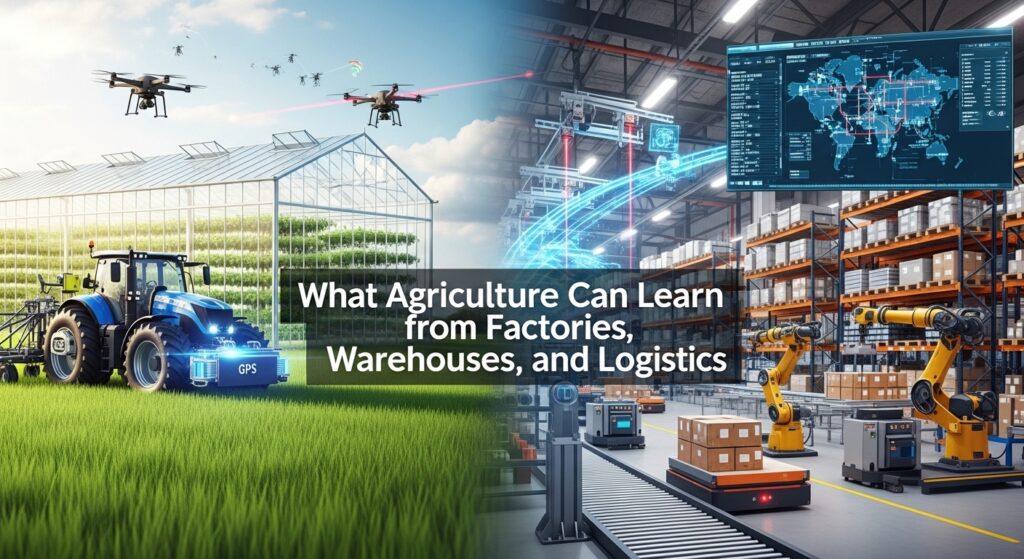
Today, the largest warehouses in the world operate with a fraction of the human labour they once required. Sensors track every shelf. Systems routes work efficiently. Automation handles the repetitive, predictable tasks, while humans focus on the decisions that require judgment.
The same story played out in manufacturing decades earlier. And in logistics. And in retail inventory. In each case, an industry dependent on large pools of manual labour faced a moment of reckoning and responded by building smarter systems.
What They Had in Common
Each of these industries shared a set of conditions before their transformation. They depended on seasonal or low-cost labour that was becoming harder to find. They made decisions based on experience and observation rather than real-time data. Their operations were largely invisible; what was happening in the facility or on the route was known only to the people physically present. And small inefficiencies, multiplied across large operations, created enormous hidden costs. These are not abstract problems. They are the same conditions most farms face today.
The parallels are not accidental. Agriculture is a complex operation. It involves timing, resources, coordination, observation, and response to the same core challenges that technology has already solved in other contexts. The difference is that agriculture was slower to digitise, and the solutions are only now becoming accessible at the scale that smallholder and medium-sized farms require.
The Pattern Always Begins the Same Way
In every industry that has undergone this transformation, the pattern starts the same way: with data. Before factories could automate production lines, they had to understand their production lines. Before warehouses could deploy intelligent routing, they had to map their inventory. Before logistics companies could optimize their routes, they had to measure every journey.
The insight was always the same. You cannot improve what you cannot see. And you cannot automate what you do not yet understand. This is why the first step in agricultural transformation is not a drone or a robot. It is a record. A clear, consistent, digital record of what is happening on the farm, which fields are being used, what inputs are applied, what the results look like over time, where the time and money are actually going. That record is what makes everything else possible. It is the foundation that intelligent systems are built on.
Agriculture Is Not Different
Some argue that farming is different in that it is too unpredictable, too dependent on nature, too varied across regions and seasons for systematic technology to work. This argument was made in manufacturing too, and in logistics, and in healthcare. Every industry believes, at some point, that its complexity makes it the exception.
But the complexity of agriculture is exactly why technology matters more, not less. Weather changes unpredictably. Pest pressure shifts. Market conditions fluctuate. Labour availability varies with the season. Each of these variables is something that data, sensors, and smart systems can help manage more consistently than human observation alone. The farms that dismiss technology as unsuited to their context are often the ones with the most to gain from it. Not because their challenges are simple, but because their challenges are real and technology, applied thoughtfully, was built precisely for challenges like these.
The Resistance Worth Acknowledging
There is a genuine concern worth addressing. When other industries automated, jobs were displaced. Workers who built their skills around manual processes found those skills becoming less central. Agriculture is aware of this. Farmers who have spent decades developing knowledge of their land, their crops, and their local conditions worry about what it means when systems start making recommendations.
The experience of other industries suggests something important here. Automation did not eliminate skilled workers, it changed what their skills were applied to. The factory worker who once operated a single machine became the technician who managed an automated line. The warehouse picker became the logistics coordinator who ensured the system was running well. The value of human judgment did not disappear. It moved upstream. For farmers, this matters. The knowledge of the land does not become irrelevant when a sensor monitors the soil. It becomes the context in which the sensor’s data is interpreted. Experience and technology are not in competition. When combined, they produce outcomes neither can achieve alone.
What Comes Next
The industries that transformed earliest are now the most competitive, the most resilient to labour shortages, and the most capable of scaling with demand. Those that delayed found the gap increasingly difficult to close. Agriculture does not need to wait for a perfect solution to arrive. The first step is already available: building the digital foundation that makes everything else possible. Organising farm operations. Recording what happens, when, and why. Creating the clarity that allows better decisions to be made and that will eventually allow smarter systems to take on the work that does not require a human to be standing in a field.
Every industry that faced this moment chose, eventually, to move forward. The ones that moved forward intentionally and early were the ones that shaped what came next.