You’re working sunrise to sunset, but are you actually making money? Most small farmers can’t answer that question with confidence, and that’s a huge problem.
Financial management sounds boring and complicated. Numbers, spreadsheets, accounting terminology, it’s enough to make any farmer’s eyes glaze over. But here’s the truth: understanding your farm finances is the difference between barely surviving and genuinely thriving.
The good news? Farm financial management doesn’t require an accounting degree. You just need to track a few key things consistently and understand what they’re telling you.
This guide will show you exactly how to take control of your farm finances, even if you’ve never tracked a single expense before.
Why Financial Management Matters More Than You Think
Let me tell you about two farmers in the same village:
Farmer A works incredibly hard. Up before dawn, in the fields until dusk. Grows multiple crops. Always busy. At harvest, he sells everything and has some cash. He thinks, “Good season.”
Farmer B also works hard. But every evening, he spends 5 minutes recording his expenses and activities. He knows exactly what each crop costs to produce, which fields are most profitable, and where his money goes.
Ten years later:
Farmer A is still working just as hard but can’t afford to send all his children to school. He’s not sure if he’s making progress or just spinning his wheels.
Farmer B has doubled his farm size, sent all his children to university, and built a new house. He’s not working harder, he’s working smarter, guided by his financial data.
The difference? Farmer B knows his numbers. He makes informed decisions. He optimizes based on reality, not guesswork. That’s the power of financial management.
The Three Financial Questions Every Farmer Must Answer
All of farm financial management boils down to three simple but critical questions that every farmer should be able to answer.
Where is my money going? Without tracking expenses, you’re flying blind about your own operation. You might think fertilizer is your biggest cost, but maybe it’s actually diesel fuel, or hired labor, or veterinary care. You can’t optimize what you don’t measure, so understanding expense flows is the foundation of financial management.
Where is my money coming from? You need to know which crops, animals, or activities actually generate income. Which ones are genuinely contributing to your bottom line, and which are just keeping you busy without generating meaningful revenue?
Am I actually making a profit? This is the most important question of all, yet most small farmers genuinely can’t answer it with confidence. This gap in knowledge is a huge problem. Revenue doesn’t equal profit. You might be generating lots of income but losing money once all costs are accounted for. You could be working extremely hard while your farm slowly bleeds money.
Once you can confidently answer these three questions, you can make truly strategic decisions about how to run your farm more profitably.
The Essential Components of Farm Financial Management
Let’s break down exactly what you need to track and why each component matters to understanding your farm’s finances.
Expense Tracking is the foundation of farm financial management. You need to record every single thing you spend money on for your farm. The categories are broad but important to distinguish: seeds and planting materials that start your crops, fertilizers and soil amendments for soil fertility, pesticides and herbicides for crop protection, water and irrigation costs including pumping and system maintenance, fuel and energy like diesel and electricity for farm operations, labor costs including hired workers, contract labor, and yes, even family labor that you assign an economic value to, equipment and tools purchases and maintenance, veterinary care and animal health services for livestock operations, feed and fodder for animals, transport and logistics costs for getting inputs to your farm and products to market, rent or land payments if applicable, loans and interest payments you’re making on farm debt, and miscellaneous expenses like storage, packaging, and licenses.
Why does tracking matter so much? You can’t reduce costs if you don’t know where money is going. Tracking reveals waste, identifies cost-saving opportunities, and shows you exactly how much each crop or activity really costs to produce. The key to making expense tracking easy is to record expenses the day they happen rather than waiting until the end of the week or month. Use your phone to quickly log purchases immediately when you make them. Take photos of receipts so you have documentation. Make it a non-negotiable habit, as essential as locking your barn at night.
Income Tracking captures every source of revenue from your farm. You need to record what you sold (which crop, animal, or product), how much you sold (quantity), the price you received, who bought it, when the sale occurred, how you were paid (cash, mobile money, credit), and when you actually received the payment if that’s different from the sale date. This information matters tremendously because understanding your income streams shows you which activities generate the most revenue, which buyers consistently pay the best prices, which sales channels are most profitable, and how income varies seasonally so you can plan your cash flow accordingly.
A common mistake farmers make is only tracking major sales while ignoring small income sources. The reality is that those small sales add up significantly over a season. Track everything, including eggs sold at the market, surplus vegetables sold to neighbors, and animal sales that seem minor. Every source of income contributes to your total picture.
Activity Tracking documents what you actually do on your farm. Key activities to log include land preparation and planting work (documenting what you planted, where, when, and how much), fertilizer and pesticide applications (recording the product, quantity, location, and date of application), irrigation events (noting time, duration, and area irrigated), weeding and crop maintenance work, harvesting activities (crop, area, quantity, and date), livestock care and management activities, and equipment usage and maintenance. These activities matter because they connect directly to both costs and results. This data lets you calculate which practices deliver the best results, understand labor requirements for future planning, correlate timing with outcomes (did early planting increase yields?), and identify efficiency improvements throughout your operation.
Inventory Management tracks what you have on hand. This includes inputs in storage (seeds, fertilizers, pesticides you have available), harvested products awaiting sale, feed and supplies for animals, and fuel and materials in stock. Why does this matter? Knowing what you have prevents over-buying that wastes money on unnecessary inventory, prevents under-buying that leaves you short during critical periods, minimizes spoilage and waste, and prevents stockouts that delay your farm activities when you need supplies.
Common Financial Mistakes Small Farmers Make
Mistake 1: Not Tracking Family Labor as a Cost Many farmers think, “I don’t pay myself, so it’s free.” But this logic is flawed. Your time has value, real economic value. If you’re not making enough to compensate yourself fairly for the work you put in, then you’re working for free, and that’s not sustainable over the long term. The solution is to assign a reasonable hourly wage to your labor and family labor. Include it in your costs just like you would hire labor. Now you can see if your farm actually generates enough profit to support your family at a reasonable standard of living.
Mistake 2: Ignoring Small Expenses Another common error is tracking big purchases like fertilizer and seeds while ignoring small daily expenses like transport, snacks for workers, and small repairs. The problem is that those small expenses add up to thousands over a season, often 15-25% of total costs when totaled. The solution is straightforward: track everything, no matter how small. When you do, you’ll be shocked at where money is actually going and where you have opportunities to optimize.
Mistake 3: Mixing Farm and Personal Finances Many farmers blur the line between farm business and personal household expenses, using farm income for household expenses without accounting for it, or using household money for farm costs without tracking it. The result is complete confusion about whether your farm is actually profitable. The solution is to treat your farm as a separate business. When you take money from the farm for personal use, record it as “owner draw” or “personal expense.” When you invest personal money in the farm, record it as “owner investment.” This clarity lets you understand actual farm profitability.
Mistake 4: Not Planning for Seasonal Cash Flow A major challenge is that farm income comes in large lumps at harvest time, but expenses happen continuously throughout the year. Many farmers spend everything after harvest, then have no cash available during the growing season when they need it. The solution is to budget your harvest income to cover lean periods strategically. Set aside money for next season’s input costs immediately after harvest, before you’re tempted to spend it all.
Mistake 5: Not Comparing Across Seasons Tracking one season tells you what happened that year, but doesn’t reveal trends or patterns over time. The solution is to build multi-season data. Compare year-over-year results. Are profits increasing over time? Are costs rising faster than income? Is efficiency improving? Trends reveal the real story of your farm’s direction.
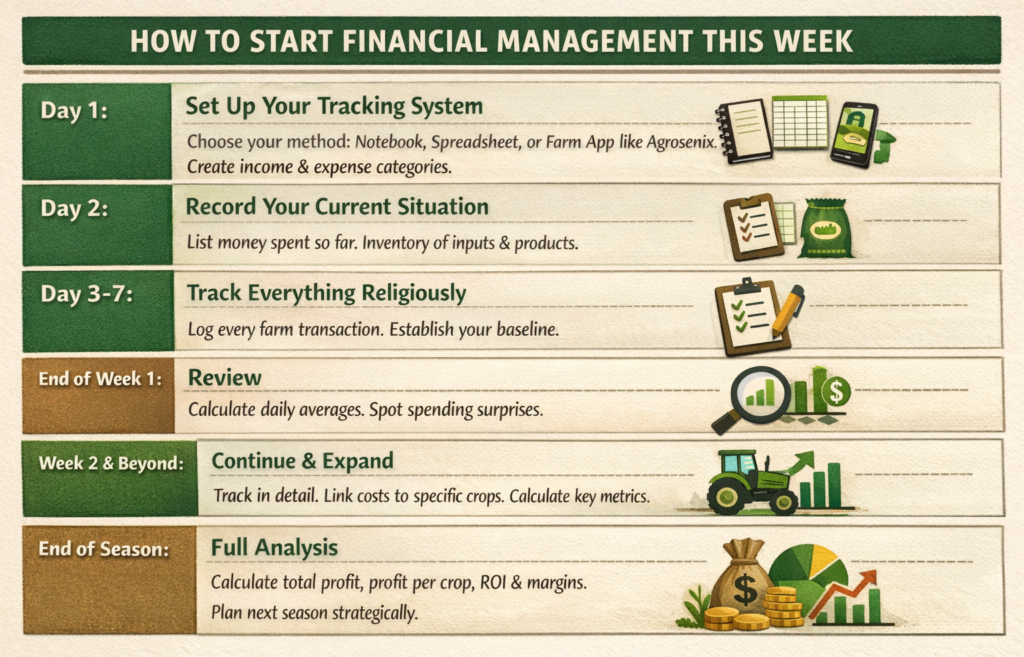
How to Start Financial Management This Week
A simple, week-by-week guide to help farmers start managing their finances effectively. It walks through setting up a tracking system, recording expenses, reviewing spending patterns, and analyzing profits, so better decisions can be made throughout the season and for future planning.
Technology Makes Financial Management Effortless
Modern farm management apps eliminate the tedious parts of financial tracking while giving you powerful insights automatically, making the whole process less burdensome and more rewarding.
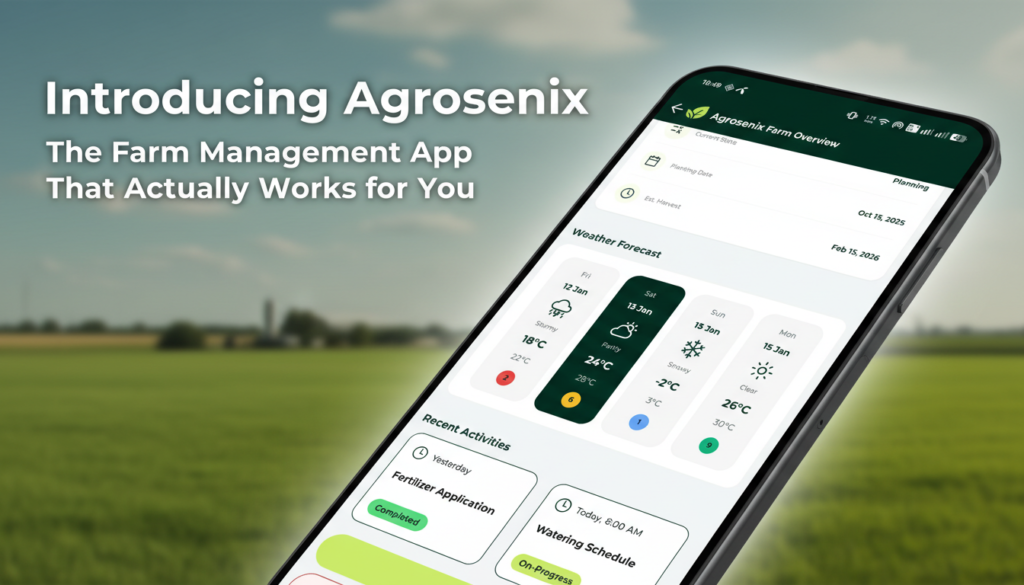
With Agrosenix you get several advantages. Quick expense recording takes just 30 seconds, tap a few buttons, take a photo of the receipt, and you’re done, compared to 10 minutes of writing in a notebook. The app does automatic categorization by suggesting categories based on your entries as it learns your patterns. You get instant financial reports showing profit per crop, expense breakdowns, and income trends, all automatically calculated and beautifully visualized so you can understand them at a glance. Multi-season comparison lets you compare this year to last year with one tap, revealing trends over time. The app works offline, so you can record expenses in the field without internet connectivity, and it syncs later automatically. Your data gets cloud backup protection, so you never lose your critical financial records even if your phone breaks. The system includes ROI calculators where you enter an investment and its projected returns, and immediately see if it’s worth doing financially.
The beauty of using technology is that the app does all the math, creates all the charts, and tracks all the trends, you just enter basic data about what you spent and what you earned. This makes financial management accessible and manageable even if you’ve always been intimidated by numbers in the past.
The Long-Term Payoff
Here’s what happens when you commit to financial management for 2-3 years:
Year 1: You discover where money actually goes (surprises everywhere). You identify and eliminate the worst cost leaks. You stop growing unprofitable crops. You increase profit by 15-25% from these basic optimizations.
Year 2: You have comparison data. You make informed planting decisions based on what actually worked financially. You negotiate better with buyers because you know your true costs. You invest strategically in high-ROI improvements. Profit increases another 15-20%.
Year 3: You have rock-solid multi-year data. You understand your seasonal patterns deeply. You optimize every aspect of your operation. Banks take you seriously for loans because you have professional financial records. You’re confident in making big decisions because you have data to back them up.
Beyond: You’re running a professional farming business, not just working hard and hoping. Your farm generates reliable profit. You can plan for major investments. You can expand strategically. You’re building real wealth, not just surviving season to season.
Your Financial Future Starts Today
You can continue farming the way you always have: working hard, hoping for good outcomes, never quite sure if you’re actually getting ahead. Or you can start tracking your finances today and transform uncertainty into clarity, guesswork into strategy, and hard work into genuine prosperity. It takes 5-10 minutes per day. That’s all. Those few minutes will be the highest-ROI activity on your entire farm.
Your farm finances matter. Start tracking them today.
Take Control of Your Farm Finances with Agrosenix
Agrosenix makes farm financial management effortless by putting the tools you need right in your pocket. Simple expense tracking lets you record purchases in seconds, even when you’re offline in the field. Automated calculations handle profit, ROI, and margin calculations automatically without any work on your part. Visual financial reports show you exactly where money goes with beautiful charts that are easy to understand at a glance. Crop profitability analysis reveals which crops actually make money and which don’t, so you can make informed planting decisions. Multi-season comparison lets you track financial improvement over time as you refine your operations. The app works offline so you can record transactions anywhere, and syncs automatically later when you get connectivity. Your financial data gets secure cloud backup, so you never lose your critical records.
Stop guessing whether your farm is profitable. Download Agrosenix and know for certain.
Ready to take control of your farm finances? Download the Agrosenix beta app and start tracking today. Free during beta. Simple financial management designed for busy farmers. Works offline.
Your farm’s financial future is too important to leave to chance. Start tracking today.