Across the world, farmers are facing a challenge that is becoming harder to ignore: there simply aren’t enough hands to work the land.
Seasonal workers are becoming scarce, younger generations are moving away from rural areas, and labor costs continue to rise. Tasks that once depended on large teams for planting, irrigation, monitoring, harvesting, and maintenance, now often fall on just a few people. For many farms, especially small and medium-sized ones, this creates constant pressure. Work piles up, timing becomes difficult, and important activities get delayed.
Agriculture has always depended on human effort. But today, relying only on manual labor is no longer sustainable.
The labour shortage is real, and it’s reshaping how farms must operate.
The hidden cost of fewer workers
When there aren’t enough workers, the impact goes far beyond simple inconvenience.
Planting may happen later than planned. Irrigation schedules get inconsistent. Pests or diseases are noticed too late. Harvest windows are missed. Small delays slowly turn into reduced yields and lost income. Even worse, the remaining workers often carry heavier loads, leading to fatigue and mistakes. Farming becomes reactive rather than planned. Instead of focusing on improving productivity, farmers spend most of their time just trying to keep up. Over time, this constant pressure affects both profitability and quality of life. And hiring more people isn’t always the solution. In many regions, skilled agricultural labor is simply not available, no matter the wage.
So, the question becomes clear: if we can’t always increase labor, how can we increase efficiency?
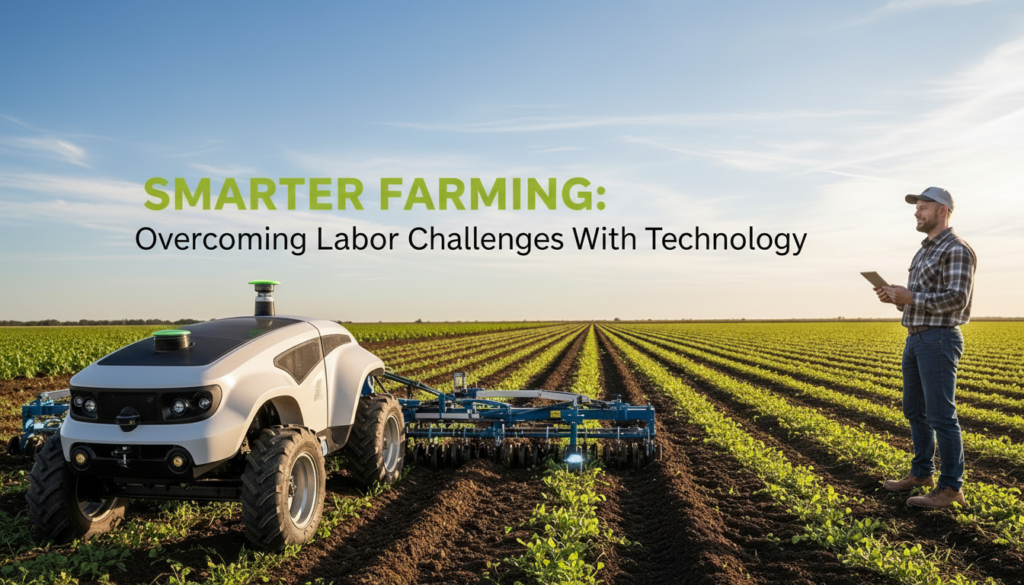
Working harder is not the answer. Working smarter is. Technology offers a different path, not by replacing farmers, but by supporting them. The goal isn’t to remove the human element from agriculture. Farming will always require knowledge, experience, and care. But repetitive, time-consuming, and manual tasks can be optimized, organized, or automated. When this happens, fewer people can manage more land with less stress. In many industries, technology has already solved similar problems. Factories use automation to increase production. Logistics companies use software to optimize routes. Retail businesses use data to manage inventory. Agriculture deserves the same transformation. The real opportunity is not “doing more work,” but “wasting less effort.” This is the essence of smart farming.
It starts with visibility
When people talk about agricultural technology, they often jump straight to drones, robots, or expensive machinery. But automation in agriculture doesn’t begin there.
It begins with understanding what’s happening on the farm. Before you can automate tasks, you need to know where time, money, and labor are being spent. You need clarity about which fields require the most attention, which crops demand the most work, and where inefficiencies exist. Without that visibility, technology becomes guesswork. With visibility, technology becomes strategy. This is why digital farm management is such an important first step. When daily activities, costs, and operations are recorded and organized, farmers can see patterns clearly. They can identify tasks that consume too much time and discover where processes can be simplified or automated. Often, just organizing information saves hours every week, time that can be reinvested into more valuable work. This directly improves farm efficiency.
How technology reduces labor pressure
When farms adopt the right tools, small improvements quickly add up. Scheduling irrigation based on real data reduces constant manual checking. Digital records eliminate paperwork and repeated calculations. Weather integration helps plan tasks at the right time instead of reacting too late. Performance insights help farmers focus only on what truly matters, rather than spreading effort everywhere.
Gradually, fewer people can manage the same workload, sometimes even more, with less stress. And this is only the beginning. As farms collect more data, they unlock the possibility of smarter systems: automated irrigation that waters only when needed, sensors that monitor soil conditions, drones that inspect crops faster than walking the fields, and predictive tools that prevent problems before they appear. All of these innovations share one purpose: helping farmers do more with less manual effort, supporting sustainable agriculture.
Building the foundation for smarter farming
At Agrosenix, we see labor shortage not just as a challenge, but as a reason to rethink how farming works. Instead of starting with complex machines, we focus first on building a digital foundation. Our platform helps farmers track their land, activities, expenses, and performance in one simple system. By organizing everyday operations, we help farms become more efficient immediately, even before advanced automation is introduced.
Because once you understand your farm clearly, you naturally discover smarter ways to work.
And when the foundation is strong, future technologies like smart irrigation, renewable energy systems, and drone-based operations become far more effective. Automation isn’t about replacing people. It’s about freeing them to focus on what truly matters.
The future of agriculture
Labour shortages will likely continue. Rural populations are shrinking, and the demand for food is only increasing. Doing things, the old way will only become harder. But technology gives agriculture a chance to evolve. A future where fewer people can manage farms confidently. Where decisions are based on data instead of stress. Where systems support farmers instead of exhausting them. That future is not far away. It starts with small, practical steps today. Because smarter agriculture isn’t about working longer hours.
It’s about working intelligently.
Agrosenix — Bring Automation in Agriculture.