Imagine knowing three months before harvest exactly how much you’ll produce, what price you should expect, and which buyer will pay you the most. That’s not fortune telling, it’s data-driven market planning.
Most farmers approach harvest season reactively. They harvest when crops are ready, then scramble to find buyers willing to purchase their produce at whatever price is offered that day. They have little leverage in negotiations because they need to sell quickly before crops spoil. They lack information about alternative buyers or market prices in other locations. They’re essentially price takers rather than price makers in their own business.
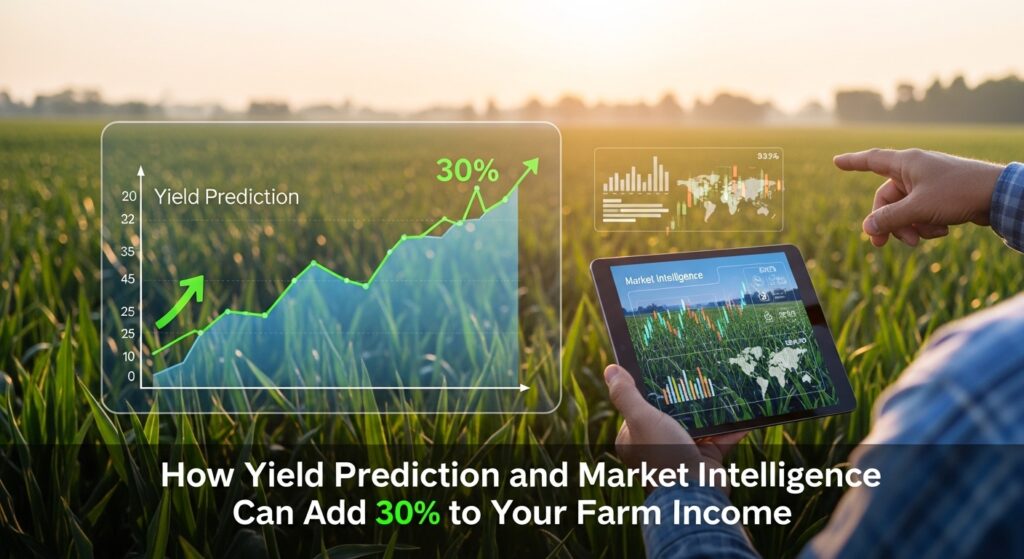
This approach leaves enormous money on the table. Better market timing, improved buyer selection, and strategic negotiation based on solid production forecasts can easily add 20-30% to farm income without producing a single additional kilogram of crops. But accessing these benefits requires two capabilities most farmers lack: accurate yield prediction knowing what you’ll harvest before it happens, and market intelligence understanding prices, buyers, and timing to optimize sales strategy.
Smart farm management systems provide both capabilities, transforming farmers from reactive price-takers to strategic market participants who capture fair value for their production.
The Cost of Market Blindness
Consider the typical farmer’s harvest and sales experience. Weeks before harvest, buyers may inquire about availability, but you can only guess how much you’ll have. When harvest begins, you discover actual yields (often different from your guess), creating either surplus or shortage you didn’t plan for. Immediately after harvest, you need to sell quickly, especially for perishable products, giving you almost no negotiating power or time to shop around for better prices.
Without market intelligence, you don’t know what prices other farmers are getting in your region, what prices are prevailing in urban markets you might access, which buyers have the best reputation for fair dealing and prompt payment, or whether prices are likely to rise or fall in coming days based on regional supply dynamics. So you sell to whoever shows up, accept the offered price because you don’t know if it’s fair, and hope you didn’t leave money on the table, though you probably did.
These losses are completely avoidable with yield prediction and market intelligence. You don’t need to produce more, you just need to sell smarter.
How Yield Prediction Works
Yield prediction uses data from your farm’s history, current crop conditions, weather patterns, and crop growth modeling to forecast harvest quantities weeks or even months in advance, with increasing accuracy as harvest approaches.
Early-season predictions (3-4 months before harvest) are based on planted area, crop variety, typical yields for those conditions, and seasonal weather forecasts. These give rough estimates useful for planning. “Your 2 hectares of maize should produce approximately 5-7 tons based on typical yields and forecasted weather” provides an initial planning number.
Mid-season predictions (1-2 months before harvest) incorporate actual crop progress, weather conditions experienced so far, any pest or disease issues that affected growth, and updated weather forecasts for the remaining growing period. “Based on current crop condition and weather, forecast yield is 6.2 tons from your maize” provides increased confidence for market planning.
Late-season predictions (2-4 weeks before harvest) use near-final crop conditions, accurate growth stage data, final weather conditions, and field sampling if available. “Harvest forecast: 6.4 tons of maize expected in 18-22 days” provides the accuracy you need for final buyer negotiations and logistics planning.
This progressive refinement means you can make strategic decisions at each stage. Early forecasts inform which buyers to contact and whether you need storage. Mid-season forecasts allow you to negotiate terms with buyers showing credible production capacity. Late forecasts enable final logistics and sales execution with confidence.
Market Intelligence: Knowing Your Options
Market intelligence provides the information you need to make strategic sales decisions rather than accepting whatever is immediately available. Real-time price data shows current prices at different markets (local, regional, urban), price trends over recent days and weeks helping you understand market direction, and price comparisons across different buyers allowing you to quickly identify best offers.
Buyer information includes buyer reputation and reliability scores from other farmers, payment terms and speed different buyers typically deliver, quality requirements and grading practices that affect your final price, and transport logistics or collection services some buyers provide. Seasonal patterns show historical price trends for your crops, typical harvest season timing and supply peaks when prices drop, and off-season demand periods when prices rise significantly. Market forecasts analyze regional supply and demand indicators, weather impacts on overall supply affecting prices, and specific opportunities or gluts developing in real-time.
Armed with this intelligence, you make informed decisions. Should you sell immediately at harvest or store for higher prices later? Which buyer offers the best combination of price, reliability, and convenience? Is it worth transporting to a more distant market given transport costs and price differential? Should you process or add value before selling rather than selling raw?
These decisions significantly impact your income, and they’re only possible with solid market intelligence backing them up.
Strategic Sales Timing
One of the most powerful applications of yield prediction and market intelligence is strategic sales timing, choosing when to sell to maximize value rather than selling immediately at harvest when supply peaks and prices bottom out.
Harvest season selling creates predictable price patterns. During the main harvest, supply floods the market and prices fall to their lowest point of the year. Farmers who must sell immediately (due to lack of storage or immediate cash needs) get the worst prices. Weeks or months after the main harvest, supply tightens as stored produce is consumed and prices rise significantly. Farmers with storage capacity and market timing intelligence capture these premium prices.
The economic impact is substantial. For many crops, prices rise 30-60% between harvest season lows and off-season peaks. Even if you incur storage costs, the price differential often far exceeds those costs, making storage profitable. But without yield prediction and market forecasting, you don’t know whether storage will pay off or how long to hold before selling.
Smart systems provide storage decision support by forecasting likely price trends based on regional supply data, calculating storage costs versus expected price increases to determine profitability, recommending optimal selling periods based on your specific situation and market conditions, and alerting you when prices reach your target level so you sell at the right moment.
Negotiating from Strength
Buyers respect farmers who demonstrate professional capacity and credible knowledge. When you can confidently state your production quantity, quality, and timeline backed by data, you negotiate from strength rather than weakness.
Pre-harvest contracting becomes possible when you can credibly forecast production weeks or months in advance. You approach buyers before harvest with solid production forecasts, negotiate prices and terms in advance before harvest price pressure hits, secure commitments reducing your market risk, and sometimes achieve better prices through advance contracts than selling spots at harvest. Buyers value reliability and advance planning, often paying premium prices to farmers who demonstrate these professional qualities.
Competitive bidding happens when you have time and market intelligence to shop around. Contact multiple potential buyers and compare offers, understand market context to evaluate whether offers are fair, confidently decline low offers knowing you have alternatives, and use competitive tension to negotiate better terms or prices. This is only possible when you’re not desperately selling immediately after harvest with no knowledge of alternative buyers or market prices.
Quality-based pricing comes from documentation and credible quality assurance. Smart farm management systems document your production practices throughout the growing season, provide traceability showing inputs used and activities performed, demonstrate quality compliance for organic, GAP, or other certifications requiring documentation, and justify premium pricing based on verified practices rather than just your word.
Buyers increasingly want traceability and quality assurance. Farmers who can provide documentation command significantly better prices than farmers selling commoditized production without quality differentiation. The same tomatoes grown organically with documentation might sell for 40% more than conventionally grown tomatoes without records, even though the production cost differential is much less.
Crop Planning Based on Market Demand
Yield prediction and market intelligence work backwards too, informing what you should plant next season based on market demand and profitability rather than tradition or habit.
Market-driven crop selection analyzes which crops commanded best prices in recent seasons, which showed price trends indicating growing demand, which have favorable supply-demand balance rather than oversupply situations, and which buyers are actively seeking suppliers for products they struggle to source. This intelligence might reveal opportunities you never considered.
For example, a farmer always planted maize because “that’s what we grow here” might discover through market data that local buyer demand for soybeans is strong but undersupplied, offering 35% better profit margins than maize. If he shifted even 30% of his land to soybeans based on market intelligence, his total farm income would increase significantly without working harder, just working smarter by responding to market signals.
Variety selection within crops is equally important. Not all maize is equal in the market. Some varieties command premium prices for specific end uses. Some have quality characteristics buyers prefer. Market intelligence reveals these preferences so you plant varieties that will sell best rather than whatever seeds are available at the shop.
Harvest timing planning uses market patterns to inform planting dates. If you know that tomato prices peak in September due to supply gaps, you can plan your planting to harvest during that window rather than during the main season when prices crash. This strategic timing based on market patterns rather than just weather and tradition can dramatically improve profitability.
The whole farm plan becomes market-responsive rather than tradition-driven. You’re farming for the market, planting what buyers want when they want it, rather than producing crops and hoping buyers materialize. This fundamental shift transforms farming from subsistence thinking to business thinking.
Accessing Premium and Export Markets
Standard commodity markets treat all production equivalently, paying average prices. Premium and export markets pay significantly more but require capabilities most farmers lack: consistent quality meeting specific standards, reliable volume supply for commercial-scale operations, traceability and documentation proving production practices, and professional business practices including contracts, logistics, and communication.
Smart farm management systems provide the documentation and professional capacity premium markets require. Quality certification support helps you document practices required for organic, fair trade, GAP, or other certifications, track compliance throughout growing season automatically, generate the reports certifying bodies need, and maintain certification status through systematic compliance rather than hoping you remember requirements.
Volume aggregation connects you with other farmers or cooperatives to pool production reaching minimum volumes export buyers require. A single smallholder producing 2 tons doesn’t interest an exporter, but 20 farmers each producing 2 tons equals 40 tons—enough to justify export logistics. Digital systems facilitate this aggregation and coordination.
Export documentation creates the paper trail international trade requires—phytosanitary certificates, origin documentation, quality reports, and traceability records that export markets demand. Smart systems generate this documentation automatically from your farm records rather than requiring manual compilation.
Professional business practices signal that you’re a reliable partner worth premium pricing. When you respond to buyer inquiries with credible production forecasts, documented quality, and professional communication, buyers treat you as a serious supplier worth paying fairly rather than a desperate farmer to exploit with low prices.
Risk Management Through Market Diversification
Market intelligence enables diversification across different buyers and market channels, reducing risk from any single buyer or market failure.
Multiple buyer relationships mean you’re not dependent on one buyer who might drop prices or delay payments. You have alternatives and leverage to maintain fair treatment. Diverse market channels include direct sales at local markets, bulk sales to processors or cooperatives, export through organized channels, and value-added processing and direct consumer sales. Each channel has different risk profiles, quality requirements, and price points.
Strategic selling splits your production across different channels optimizing for price, speed of payment, and risk. Perhaps 40% sells to a premium buyer at best price, 30% to a reliable cooperative at moderate price but guaranteed purchase, 20% at local markets for immediate cash needs, and 10% held for processing during off-season. This diversification maximizes overall income while managing risk intelligently.
Market intelligence reveals these opportunities so you’re not locked into single-channel selling based on limited information about alternatives. The farmer who only knows local traders will only access local trader prices. The farmer with comprehensive market intelligence can strategically diversify across multiple higher-value channels.
Technology: How Agrosenix Yield Prediction and Market Intelligence Work
Agrosenix integrates multiple data sources and analytical approaches to provide actionable yield forecasts and market intelligence.
Yield prediction combines your farm’s historical yields, current season activity logs showing actual planting, crop progress, and conditions, weather data and forecasts affecting remaining growth period, and crop growth models calibrated for your specific crops and location. Machine learning algorithms analyze these factors to produce progressively refined forecasts from early season through harvest.
Market intelligence aggregates regional price data from markets, cooperatives, and trader reports, buyer information shared by farmers through community reporting, historical seasonal trends for crops in your region, and real-time supply and demand signals from the agricultural marketplace. This comprehensive market picture shows you opportunities you’d never discover looking at just your local options.
Decision support tools calculate storage profitability comparing storage costs to forecast price increases, recommend optimal sales timing based on your situation and market trends, identify buyer options ranked by price, reliability, and logistics, and alert you to market opportunities matching your production. You don’t need to analyze raw data, the system provides clear recommendations: “Store for 2-3 months, forecast price increase of 35% exceeds storage costs by 28%” or “Buyer Cooperative X offering 15% above current market average and providing transport, recommend accepting this offer.”
All of this works offline with data syncing when connectivity is available, ensuring rural farmers aren’t excluded from market intelligence and forecasting by poor internet access.
Implementation: Starting This Season
Month 1: Enable Yield Tracking by logging all crop activities as you perform them (planting area, variety, fertilizer applications, pest treatments), recording any issues affecting crop growth (drought stress, pest damage, disease), and providing current crop stage information the system needs for forecasting models.
Month 2-3: Review Early Forecasts by checking your yield forecast dashboard as predictions generate, using early forecasts for initial market planning and buyer contact, updating information if conditions change significantly (unexpected disease outbreak, weather event), and comparing forecasts to your own expectations to calibrate confidence.
Month 4 (Pre-Harvest): Enable Market Intelligence by exploring market price data for your crops in your region, researching buyer options the system recommends, contacting potential buyers with professional production forecasts to start negotiations, and making strategic storage decisions based on forecast price trends and storage cost analysis.
Harvest and Sale: Execute Market Strategy by validating that actual yields matched forecasts (improving future predictions), implementing your sales plan (immediate sales versus storage based on market intelligence), negotiating confidently from your position of knowledge and preparation, and documenting results to build track record for future buyer relationships.
Post-Season: Evaluate and Improve by comparing actual income to what you would have earned selling immediately at harvest (quantifying the value of strategic planning), analyzing what worked and what you’d adjust for next season, and using yield and market data to inform next season’s crop planning and variety selection.
The Competitive Advantage of Predictive Farming
Farming markets reward information and professional capacity. Farmers who predict production accurately, understand market dynamics, and execute strategic sales plans consistently earn 20-40% more than farmers with identical production selling reactively.
This isn’t about having more land, better weather, or superior farming skills. It’s purely about better information and better decisions enabled by that information. The yield prediction and market intelligence capabilities that were historically available only to large commercial farms with professional staff are now accessible to every farmer through smartphone-based systems.
Farmers adopting these capabilities today are positioning themselves for long-term success through consistently better prices from strategic selling, reduced risk through diversification and market intelligence, stronger buyer relationships from demonstrated reliability and professionalism, and access to premium markets requiring documentation and proven capacity.
Meanwhile, farmers continuing to sell reactively accept preventable income losses as “just how farming is,” miss opportunities for better prices and buyers they never learn about, remain dependent on single buyers or market channels increasing vulnerability, and leave 20-40% of potential income on the table through poor market timing and weak negotiation positions.
The choice is yours. Same production, but dramatically different income outcomes based purely on prediction and market intelligence.
Maximize Your Farm Income with Agrosenix
Agrosenix brings professional yield prediction and market intelligence to every farmer through progressive yield forecasting from early season through harvest, real-time market price data across buyers, markets, and regions, buyer ratings and recommendations from farmer community, seasonal trends and price forecasting for strategic decisions, storage profitability calculators supporting timing decisions, pre-harvest buyer matching connecting you with buyers seeking your crops, sales strategy recommendations optimized for your situation, and offline functionality ensuring rural farmers have full access to market intelligence.
Download Agrosenix today and start capturing the income you’re leaving on the table. Your smartphone already has everything you need to sell smarter. Stop accepting whatever price is offered. Start knowing what you should get, and getting it.
Ready to add 30% to your farm income through better market intelligence? Download the Agrosenix beta app and enable yield prediction and market tracking today. Free during beta. Works offline. Market intelligence for real farmers.
You work too hard to sell for less than your crops are worth.