Banks don’t lend to farmers because “farming is risky.” Banks don’t lend to farmers because farmers can’t prove they’re NOT risky.
Access to credit is one of the biggest challenges smallholder farmers face. You need money to buy quality seeds, sufficient fertilizer, proper pesticides, or equipment that would improve productivity. But banks and lenders won’t give you loans because you can’t demonstrate repayment capacity, provide credible financial records, show consistent income history, or document your farming operation professionally.
This credit constraint forces farmers into a cycle of under-investment. Without credit, you buy cheap inputs that deliver poor yields. Poor yields mean low income. Low income means you can’t save to invest in better inputs. Next season repeats the same pattern. You’re trapped farming at suboptimal productivity because you can’t access the capital to farm better, even though better farming would easily generate returns justifying the investment.
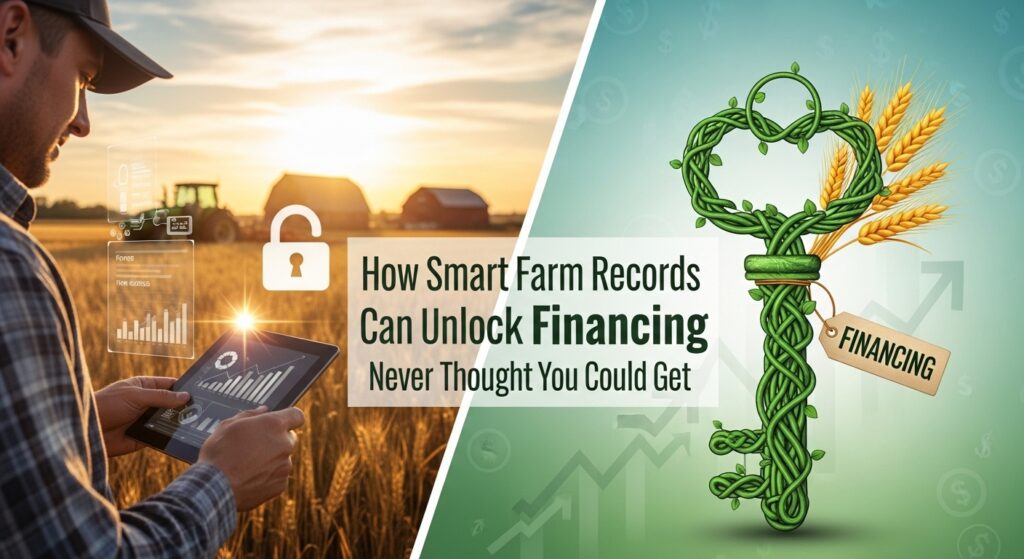
The problem isn’t that farming can’t support credit. The problem is that most farmers can’t PROVE their farms can support credit because they lack the documentation lenders require. Smart farm management changes this equation entirely by automatically generating exactly the records, documentation, and financial evidence lenders need to approve loans at reasonable terms. Professional farm records aren’t just nice to have, they’re literally the key that unlocks financing to transform your operation.
Why Lenders Won’t Finance Farmers
From a lender’s perspective, loans to undocumented farmers are extremely risky bets. Without financial records, they don’t know if the farm actually generates sufficient income to repay loans. Without activity logs, they can’t verify the farmer knows how to farm productively. Without asset documentation, they have no idea what collateral exists if the loan defaults. Without repayment history, they have no evidence the farmer is reliable and trustworthy.
So lenders either refuse entirely to work with smallholders, or charge exorbitant interest rates (30-50% annual rates in some markets) to compensate for perceived risk. Both outcomes harm farmers. Refused credit prevents investment. Exploitative interest rates make even productive investments unprofitable after financing costs.
Traditional credit sources have limitations. Microfinance can help but usually provides only small amounts insufficient for significant farm investments. Input credit from suppliers is available but often comes with strings attached (must buy from them at their prices, must sell harvest to them at their prices). Informal moneylenders charge exploitative rates (sometimes 5-10% per month) that trap farmers in debt cycles. Family and community lending helps but is limited in scale and can strain relationships if repayment is difficult.
What farmers really need is access to formal financial institutions offering larger amounts at reasonable rates (10-20% annual) with terms that match agricultural income patterns, payment at harvest rather than monthly. But these institutions require documentation to assess risk and approve loans. That documentation has been historically impossible for smallholders to produce. Until now.
How Farm Records Enable Financing
Professional farm management records transform how lenders view farmers. Documented income history proves you’re generating the revenue needed to repay loans. Expense tracking demonstrates you understand costs and manage finances responsibly. Activity logs show you’re farming systematically using proven practices. Asset records document what you own that could serve as collateral. Repayment history from previous small credits demonstrates reliability.
Together, these records create a credible business profile that makes you look like a professional business operator rather than a risky subsistence farmer. This perception shift is everything when lenders are deciding whether to approve your loan.
For example: Two farmers applying for the same 500,000 shilling loan to buy quality maize seeds, fertilizer, and improved pest management inputs.
Farmer A says: “I’ve been farming maize for 15 years. I usually harvest about 3-4 tons per hectare. I’m a good farmer and I’ll pay you back after harvest. Trust me.” He has no records, no documentation, no way to verify any claims. Lender’s assessment: too risky, loan denied.
Farmer B opens his Agrosenix app and shows: detailed records from past three seasons showing consistent harvests averaging 3.8 tons/hectare; complete financial records showing income of 1.2 million shillings annually; documented expenses of 600,000 shillings annually, demonstrating 600,000 shilling net profit that easily covers 500,000 loan repayment; activity logs showing systematic farming practices following best practices; testimonials and reputation score from cooperative manager verifying reliability. Lender’s assessment: credible business operator with documented capacity, loan approved at favorable terms.
Same farmer, same farming operation, but dramatically different lending outcomes purely because one has professional documentation and one doesn’t.
What Lenders Want to See
Understanding exactly what lenders look for helps you provide it. Income documentation shows at least 1-2 years of income history, consistent seasonal revenue patterns, and total annual income exceeding loan amount by comfortable margin (usually 2-3x minimum). If you’re asking for a 300,000 shilling loan, lenders want evidence you generate 600,000+ shilling annual income.
Expense documentation demonstrates financial responsibility by showing you track money carefully, understand where costs go, and manage expenses appropriately to your income. Lenders worry that farmers who don’t track expenses will misuse loan funds. Your expense records prove you’re financially disciplined.
Profit margins are key because lenders want positive net income, not just revenue. A farmer generating 800,000 revenue with 750,000 expenses has only 50,000 net profit, insufficient to comfortably repay a 300,000 loan. A farmer generating 800,000 revenue with 400,000 expenses has 400,000 net profit, more than enough to service significant credit.
Repayment capacity analysis shows lenders exactly how you’ll repay. Your farm generates X annual income. You have Y committed expenses. You’re requesting a Z loan amount. After expenses and loan repayment, you still have enough income to live on. This calculation proves the loan is affordable within your actual financial reality. Without data, this calculation is impossible and lenders assume you can’t afford it.
Collateral documentation lists assets you’re offering as collateral. Your land title and land value, equipment, stored crops that could secure warehouse receipt financing, or livestock registered as assets. Professional asset documentation makes collateral-based lending feasible.
Building Your Loan-Ready Profile
Even if you don’t need credit right now, start building your loan-ready profile by documenting your operation systematically. When you eventually need financing, you’ll have the track record lenders require.
In 1-3 months you can start basic tracking by recording all income and expenses religiously with no exceptions. Log major farm activities (planting, fertilizer application, pest treatments, harvesting). Document any assets you own (equipment, livestock, stored crops). This establishes your documentation practice.
In 4-6 months you can continue consistent tracking to build history. Add more detail to activity logs including specific practices and inputs used. Start tracking yield and production metrics to show productivity. Begin calculating basic profitability metrics the system generates automatically. Your documentation becomes progressively richer.
In 7-12 months you can complete your first full season of documentation showing the complete season cycle from planting through harvest and sale. Generate your first annual financial reports from accumulated data. Document any credits you repaid successfully (even small ones from cooperatives or suppliers) to begin building repayment history. Calculate accurate profit margins and ROI on investments.
In 2+ years you can build a multi-season track record showing consistency across multiple cycles. Demonstrate improving trends (increasing yields, declining input costs, growing profitability). Maintain perfect documentation habits. By now you have exactly what lenders want: credible, verified, multi-year financial history demonstrating consistent operation and profitability.
Types of Agricultural Financing You Can Access
Different financial products serve different farm needs. With proper documentation, you can access the right financing for each purpose.
Input credit finances your seasonal input purchases (seeds, fertilizer, pesticides) with repayment at harvest. This is one of the easiest credits to obtain because it’s short-term (3-6 months), directly linked to production that will generate repayment, and often secured by the harvest itself. Professional records showing past production and repayment history make input credit readily accessible. Equipment loans finance larger investments like tractors, irrigation systems, processing equipment with longer repayment periods (1-3 years) matching the useful life of the equipment. The equipment itself serves as collateral. Financial records showing sufficient income to cover loan payments plus farming operations are essential.
Working capital loans provide cash for general farm operations including labor costs, transport, temporary expenses before harvest revenue arrives. These are harder to get because they’re less directly tied to specific productive investments. Strong financial documentation is critical to access working capital at reasonable terms.
Warehouse receipt financing uses stored crops as collateral for loans while you wait for better market prices. You store your harvest (maize, coffee, etc.) in a certified warehouse receiving a receipt. You borrow against that receipt (typically 60-70% of crop value) and repay when you eventually sell the crop. This enables strategic market timing without being forced to sell immediately at harvest lows. Professional production documentation helps access this powerful financing tool.
Emergency credit provides rapid funding for crisis situations like disease outbreaks requiring urgent treatment, storm damage needing immediate repair, or unexpected family emergencies. Having established lender relationships and documented track record means you can access emergency funds quickly when disasters strike, which can save your season or your family’s welfare.
Interest Rates and Terms
Professional documentation doesn’t just enable loan approval, it improves the terms offered. Higher-risk borrowers (those without documentation) pay premium rates. Lower-risk borrowers (those with proven track records) pay substantially better rates.
Typical agricultural lending rates vary dramatically by perceived risk. Informal moneylenders might charge 5-10% per month (60-120% annually) because they view farmers as extremely risky. Microfinance institutions typically charge 25-40% annually to smallholders. Formal banks charge 15-25% annually to documented businesses with proven track records. Government or development program loans might offer subsidized rates of 8-15% annually to qualifying farmers with proper documentation.
The rate differential is enormous. A 500,000 shilling loan at 40% annual interest costs 200,000 shillings per year in interest alone. The same loan at 15% costs 75,000 shillings in interest: 125,000 shillings savings purely from better rates enabled by professional documentation.
Loan terms also improve with documentation. Undocumented farmers might get only 3-month loans requiring repayment before their harvest even arrives, creating cashflow impossibilities. Documented farmers can negotiate 6-12 month terms aligned with actual agricultural cycles, allowing repayment when harvest revenue actually arrives.
Payment schedules can match farm income patterns. Instead of monthly installments common in consumer lending, agricultural loans might require interest-only payments during the growing season with principal due at harvest. This matches payment obligations to actual cash availability, making loans affordable that would be impossible with standard monthly payment structures.
Credit Scoring for Farmers
Progressive lenders and fintech companies are developing farmer credit scoring systems based on digital farm records. Your farming activity, financial management, and repayment history generate a credit score that determines loan eligibility and terms.
Factors that improve your farmer credit score include consistency of record-keeping (regular, complete data entry demonstrates reliability), production history showing consistent or improving yields, financial discipline with controlled expenses and positive profit margins, repayment history on any previous credits (even small ones), tenure and experience in farming, and participation in training or cooperative membership indicating commitment to improvement.
As you build positive credit history, your borrowing capacity and terms improve progressively. Your first loan might be small (100,000-200,000) at moderate rates (20-25%). With successful repayment and continued documentation, your second loan could be larger (300,000-500,000) at better rates (15-20%). Eventually you access substantial financing (millions) at competitive terms (10-15%) based on your proven track record.
This progressive credit building transforms your farming operation over time. Each successful credit cycle enables larger investments in productivity improvements, generating higher returns that support larger subsequent investments. The compounding effect can scale a small subsistence operation into a thriving commercial farm within just a few years, if you have the documentation to access progressive financing.
Digital Lending Platforms
Technology is creating new lending platforms specifically for smallholder farmers, using digital farm records to automate credit assessment and disbursal. These platforms can process loan applications in hours instead of weeks, offer competitive rates because automated assessment is cheaper than manual underwriting, reach farmers in remote areas through mobile platforms, and scale to serve millions of farmers who formal banks ignore.
Digital lenders integrate with farm management systems like Agrosenix, automatically pulling your farm records, financial data, and activity history to assess your loan application. No need to manually compile reports or visit bank branches multiple times. The entire process happens digitally from application through approval to disbursement.
This is revolutionizing agricultural finance in many markets. Farmers who couldn’t access formal credit at all can now get instant mobile loans at reasonable rates based purely on their digital farm records. The same documentation that makes you attractive to traditional banks also unlocks access to innovative digital financing that’s often faster, more convenient, and more farmer-friendly.
Using Agrosenix to Build Your Credit Profile
Agrosenix automatically generates credit-ready documentation through comprehensive income tracking capturing all farm sales and revenue, detailed expense tracking showing financial discipline and cost management, activity logs documenting systematic farming practices, asset registers listing equipment, livestock, and resources, financial reports automatically calculated (profit, ROI, margins), multi-season history showing consistency and trends, credit score calculation based on your farming and financial performance, and loan application integration where your records export directly to lender platforms in formats they require.
When you apply for credit, you’re not scrambling to remember and reconstruct financial history. Everything is already documented, calculated, and ready to present professionally. Many lenders increasingly accept Agrosenix records directly as verified farm documentation because the system’s data integrity and completeness meet their requirements.
Start Building Your Credit Profile Today
Even if you don’t need credit now, start documenting today. Every season without records is a lost opportunity to build the track record you’ll eventually need. When a crisis hits or an opportunity arises requiring financing, you want documentation ready.
This month: Download Agrosenix and begin tracking all income and expenses immediately. Log your major farm activities. Document your assets. Next 3 months: Continue consistent tracking to build your first seasonal history. Don’t worry about being perfect, consistent imperfect data beats no data. Year 1: Complete your first full documented season from planting through harvest and sale, generating your first annual financial reports.
In 2+ years you can build a multi-season track record that makes you progressively more attractive to lenders. When you need financing, you’ll have exactly what lenders want to see, professional documentation proving you’re a smart investment.
Your Farm Deserves Access to Capital
Credit isn’t charity or handout. It’s business investment that should be available to productive farmers who can generate returns justifying the financing. The only thing preventing you from accessing formal credit at reasonable terms is documentation. Smart farm records solve this problem entirely.
Download Agrosenix and start building your loan-ready profile today. Every season you document is another season of track record that will unlock financing when you need it. Your farming already generates the returns that justify credit. Now you can prove it.
Stop being locked out of financing. Start documenting your way to credit access.
Ready to build the farm records that unlock financing? Download Agrosenix and start tracking today. Free during beta. Loan-ready documentation for real farmers. The credit you need already exists. You just need records to access it.