The Cost of Always Catching Up
There is a particular exhaustion that comes from reactive farming. It is not just physical. It is the exhaustion of always arriving too late, of seeing damage that could have been prevented, of spending resources correcting problems that, with the right information, would never have reached this point.
A pest infestation that required expensive treatment could have been intercepted at a fraction of the cost a week earlier. A crop showing stress symptoms today has been stressed for days already. An irrigation failure that will reduce yield this season was signalled by soil moisture data that no one was reading. The pattern repeats itself across seasons, across farms, across regions. Farmers work hard. They are skilled and knowledgeable. But without the right information at the right time, even the most experienced farmer is always one step behind what the farm actually needs. This is what reactive farming costs. Not just in money, though the financial impact is real. It costs time, energy, and the kind of quiet confidence that comes from knowing you are ahead of your operation, not chasing it.
Reactive Farming and Why It Persists
Reactive farming is not a choice. It is a consequence of limited visibility. When the only way to know the state of a field is to walk it, when the only way to track an expense is to remember it, when the only way to understand why a crop underperformed is to look back with incomplete records, the farm is structurally locked into reacting. There is simply no mechanism for early action because there is no early information. This is why reactive farming persists even among farmers who understand its costs. They are not unaware of the problem. They simply do not have the tools to solve it.
The good news is that this is changing. The information needed to shift from reactive to predictive farming is becoming more accessible. And the farms that make this shift even partially consistently experience better outcomes with less effort.
What Predictive Farming Actually Means
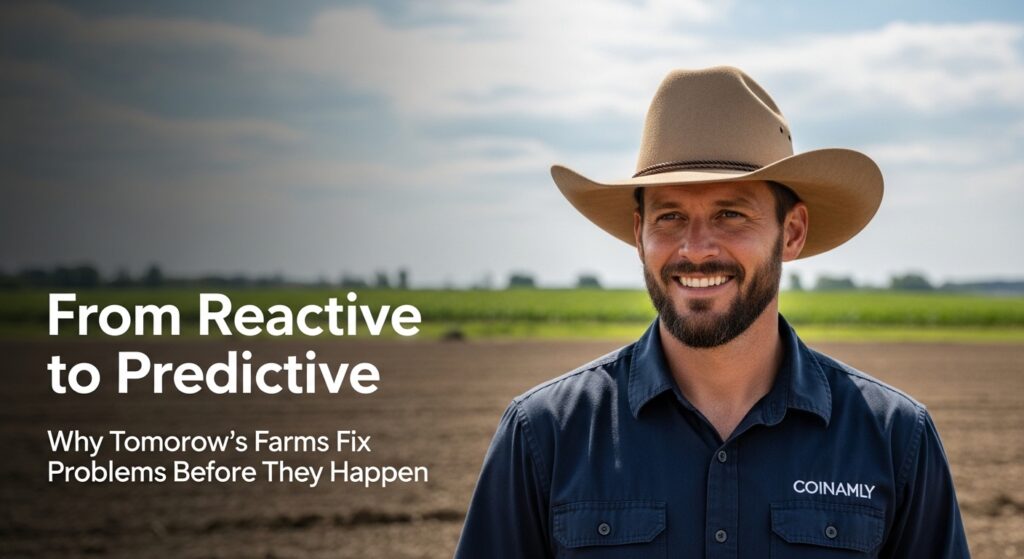
Predictive farming does not mean eliminating uncertainty. Weather, biology, and markets will always carry variables that no system can perfectly anticipate. What it means is making decisions based on evidence of what is likely to happen, rather than waiting for proof of what has already gone wrong.
It means knowing that soil moisture levels in a particular section of the field are trending toward stress before any plant shows visible symptoms. It means recognising that temperature and humidity patterns over the past week create conditions where fungal pressure is likely to increase and responding with a preventive measure rather than a corrective one. It means tracking yield data across multiple seasons and understanding which variables, when they appear, consistently predict a strong or difficult harvest.
Each of these is a prediction. Not a guarantee. But a well-informed expectation that allows the farmer to act early, when action is most effective and least costly.
The Data That Makes Prediction Possible
Prediction requires history. It requires enough accumulated, organised data to reveal patterns that a single observation could never show.
This is one of the most important reasons to begin building a digital farm record today, even if the more advanced predictive tools feel like a future concern. Every season of clean, consistent data is a season of patterns available for analysis. And those patterns, over time, become the foundation of genuine predictive capability.
A farmer who has tracked soil conditions, input applications, pest observations, and yield outcomes across five seasons has something genuinely valuable, not just as a record of the past, but as a model of how their specific land behaves under specific conditions. When those conditions appear again, the farm’s history can tell you what to expect.
This kind of farm-specific intelligence is something that no external database or general recommendation can replicate. It is built from the particular soil, the local climate, the crop varieties, and the management decisions of that specific operation, over real time. It is the most accurate predictive tool that a farm will ever have.
Small Predictions, Large Impact
Predictive farming does not have to mean sophisticated algorithms or expensive infrastructure to begin delivering value. Some of the most impactful predictions are simple. A simple weekly review of field records can reveal powerful patterns over time. You start noticing which crop, in which part of the field, and at which growth stage tends to show nutrient deficiency. When you consistently track and review this information, you can apply early preventive measures before any visible symptoms appear. No fancy sensors needed. Just well-organized data and the discipline to review it regularly.
An alert built from weather forecast data and matched with historical pest records can signal when a high-risk window is approaching for a known regional threat. It’s a simple output from a straightforward system, but it prompts action at the exact moment when intervention is cheapest and most effective. An irrigation schedule that adapts to actual rainfall data instead of following a rigid calendar prevents the routine waste of watering right before it rains. And that is predictable. Measurable. Impactful. These are not the complex use cases of machine learning and artificial intelligence, though those capabilities are coming. They are the practical starting points that are available today, to any farm that has begun organising its information.
The Shift Is Already Happening
The farms that will thrive in the next decade are not necessarily the largest or the best-resourced. They are the ones that are already building the foundation for smarter decisions. They are the farms where information is captured consistently and reviewed regularly. Where patterns are noticed and acted on. Where the response to a problem is not just to solve it, but to ask what earlier signal could have prevented it.
This shift from reactive to predictive is not a single transformation. It is an ongoing change in how a farm understands itself and responds to what it knows. It happens gradually, season by season, as more data accumulates and the patterns it reveals become clearer.
At Agrosenix, this is the future we are building toward. Not just tools that help farmers manage their operations today, but a system that helps them anticipate tomorrow. One that learns from what a farm has experienced and uses that learning to reduce the uncertainty of what comes next. The farm that is always catching up is already working as hard as it possibly can. It deserves a system that works just as hard to keep it ahead.
Contact Agrosenix to discuss cooperative solutions. Download Agrosenix. Build your path to successful growth. Works offline.
Agrosenix Bring Automation in Agriculture.