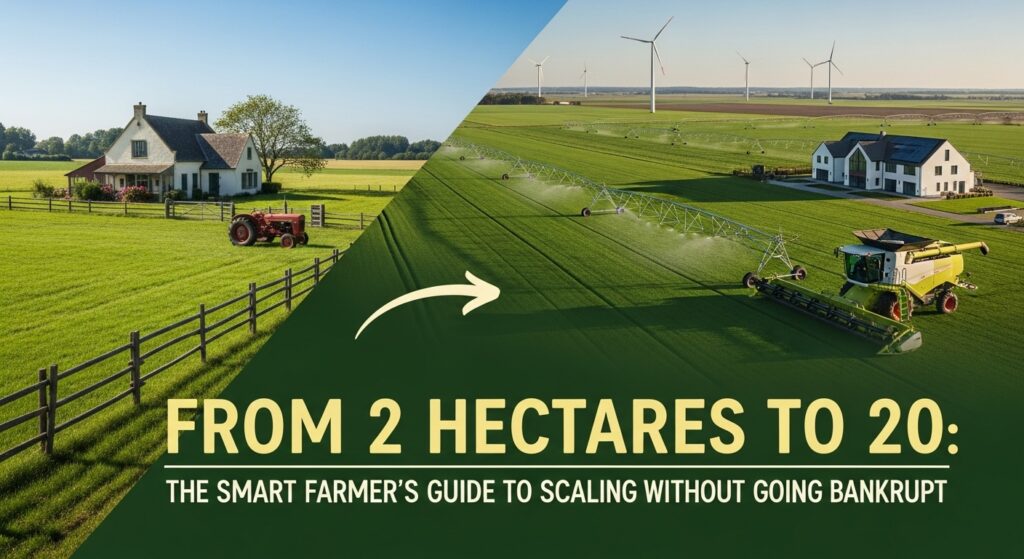
Every successful small farmer eventually faces the same tempting opportunity: expand. More land means more production means more income, right? Sometimes. And sometimes it means financial disaster.
Scaling a farm operation is one of the riskiest moves a farmer can make. Done right, it transforms a small subsistence operation into a thriving commercial enterprise generating real wealth. Done wrong, it saddles you with unmanageable debt, overwhelming complexity, cash flow crises, and potential bankruptcy that destroys everything you built.
The difference between successful scaling and disastrous over-expansion isn’t luck. It’s systematic planning, phased growth, data-driven decision making, and operational systems that can handle increased complexity without collapsing. Most farmers who try to scale fail because they expand too fast without adequate preparation, underestimate the capital required to farm larger areas properly, lack systems to manage increased complexity, assume larger scale automatically means proportional profits (it doesn’t), and don’t build the operational capacity needed before growing.
This guide shows you how to scale smartly, growing your operation systematically in ways that genuinely build wealth rather than just increasing your workload and risk.
The Scaling Paradox: Why Bigger Isn’t Always Better
Here’s a truth many farmers learn painfully: doubling your farm size does NOT double your profit. In fact, without proper management, it might decrease your profit while doubling your stress and risk.
Small farms can achieve very high profitability per hectare through intensive management. You personally oversee everything, notice problems quickly, and respond immediately. Your attention and care enable high productivity. Large farms spread your attention thinner. You can’t personally oversee every hectare. Quality of management declines unless you develop systems and supervision to maintain management intensity at scale.
Small operations have low fixed costs. Larger operations require more equipment, permanent staff, infrastructure, and financing. These fixed costs must be covered even in poor seasons. Small farms can adjust easily, plant less if finances are tight, and use more family labor. Large farms have commitments, debt payments, permanent staff salaries, equipment maintenance that don’t flex downward easily.
Small farms can sell everything quickly through direct channels. Larger production requires bulk buyers, contracts, logistics, and infrastructure that small operations don’t need. Finding markets for 5 tons is easy. Finding reliable markets for 50 tons requires professional marketing systems.
This doesn’t mean scaling is wrong, but it must be done strategically with systems that maintain or improve per-hectare profitability rather than just growing for the sake of size.
Assessing Readiness to Scale
Before expanding, honestly assess whether you’re ready. Successful scaling requires several prerequisites that many farmers lack.
Operational Excellence at Current Scale: Are you achieving strong profitability per hectare currently? Is your current operation well-organized and efficiently managed? Do you have documented systems and processes that work reliably? Are you achieving yields at or above regional averages? If your current small operation isn’t excellent, scaling just multiplies mediocrity.
Financial Capacity: Do you have adequate capital or access to financing to properly farm an increased area? Have you calculated total capital requirements including land acquisition, development, inputs, equipment, and working capital? Do you have reserves for unexpected expenses or poor seasons? Many farmers scale using debt, then discover they underestimated capital needs and can’t afford optimal inputs for the larger area, dooming profitability.
Market Access: Can you reliably sell significantly increased production at acceptable prices? Have you confirmed buyer interest and capacity for larger volumes? Do you understand logistics, quality requirements, and payment terms for larger-scale marketing? Producing 10 times more crops is pointless if you can’t sell them profitably.
Management Capacity: Can you effectively oversee a larger, more complex operation? Do you have or can you hire reliable supervisors and staff? Do you have systems that enable managing increased complexity without chaos? Many small farmers are excellent hands-on operators but lack management skills needed for larger operations requiring delegation and systems.
Risk Tolerance: Can you financially and emotionally handle the risk of larger operations? If a bad season hits, can you survive the larger losses? Do you have diversification or insurance reducing concentrated risk? Scaling means both larger potential rewards AND larger potential losses.
If you honestly answer “not yet” to several of these questions, you’re not ready to scale. Strengthen these areas first at current scale before expanding.
The Phased Scaling Approach
Smart scaling happens gradually in phases that build capacity systematically rather than dramatic expansions that bet everything on succeeding immediately.
Phase 1: Optimize Current Operations (1-2 seasons): Before expanding, maximize profitability and efficiency of your current area. Implement systematic record-keeping documenting all operations. Optimize input usage reducing waste. Improve yields through better practices. Develop marketing systems and buyer relationships. Generate strong profitability and cash flow that can fund expansion. Document processes and systems that work. This foundation is critical, scaling optimized operations multiplies success, while scaling mediocre operations multiplies problems.
Phase 2: Small Expansion (1-2 seasons): Add 25-50% to your current area, not 2-3x. Use earnings from Phase 1 to finance expansion conservatively. Test your systems at a slightly larger scale. Identify bottlenecks and solve them while scale is still manageable. Maintain or improve per-hectare profitability, if profitability declines with modest expansion, don’t proceed further. Prove you can manage moderate growth successfully.
Phase 3: Consolidation and System Building (1-2 seasons): Don’t expand again yet. Consolidate at a new scale, refining operations until they’re excellent. Build systems for supervision, quality control, financial management, and operations. Hire and train key staff if needed. Strengthen market relationships for larger volumes. Generate strong financial performance at this intermediate scale. This phase is where many farmers fail by skipping consolidation and expanding too quickly.
Phase 4: Strategic Growth (3+ seasons): With proven systems and strong performance, expand strategically toward target scale. Grow in increments, consolidating between expansions. Maintain per-hectare profitability rigorously, if it declines, stop and consolidate. Build a professional business rather than just a larger farm. Scale becomes sustainable when supported by mature systems.
This phased approach takes 5-10 years to reach large scale, which frustrates impatient farmers wanting rapid growth. But it’s far more likely to succeed than dramatic expansion betting everything on unproven systems.
Capital Requirements:The Math of Scaling
Under-capitalization kills most scaling attempts. Accurately calculating and securing necessary capital is crucial.
Land Acquisition/Lease: Budget purchase price or multiple years’ lease payments, land must be secured long enough to justify development investments.
Land Development: Virgin land requires clearing, soil preparation, possibly terracing or drainage. Degraded land might need soil improvement. These are significant costs before you plant anything.
Infrastructure Investment: Larger operations need storage facilities, irrigation systems, equipment housing, possibly on-site housing for workers, fencing and security, access roads, and water sources. These capital costs don’t directly generate income but enable operations.
Equipment and Machinery: Calculate tractors, plows, planters, sprayers, irrigation equipment, harvest tools, transport vehicles, processing equipment if applicable. Can you afford outright purchase or must you plan equipment financing?
Working Capital: Budget seasonal input costs (proportional to area), labor costs (often higher per hectare for larger operations using more hired labor), operating expenses (fuel, maintenance, utilities), and reserves for unexpected expenses. Many farmers secure land but lack working capital to farm it properly.
Debt Service: If using financing, calculate debt payments (principal and interest) throughout the growth period. These are fixed obligations reducing available cash even in difficult years.
Total capital requirements for scaling might be 3-5 times larger than naive estimates. A farmer thinking “I’ll double my farm from 5 to 10 hectares, should cost double what I currently spend” discovers actual costs are 3-4 times current spending due to infrastructure, equipment, working capital, and financing costs beyond simple input multiplication.
Conservative financial planning with adequate capital buffers is essential. Under-capitalized scaling attempts cut corners, using insufficient inputs, inadequate infrastructure, poor equipment, undermining productivity and profitability.
Operational Systems for Scale
Small operations run on owner attention and intuition. Scaled operations require documented systems, procedures, and oversight structures.
Standard Operating Procedures: Document how key activities should be performed, planting procedures, fertilizer application rates and timing, pest management protocols, harvesting methods, quality standards, and safety procedures. Staff can follow documented procedures achieving consistent results without constant owner oversight.
Supervision and Oversight: Hire and train field supervisors who oversee daily operations and report to you. Establish reporting systems so you know what’s happening across expanded operations. Create accountability structures ensuring work gets done to standard. Without supervision systems, quality declines as scale increases because you can’t personally oversee everything.
Quality Control Systems: Define quality standards for all outputs and processes. Implement regular inspections and measurements. Create feedback loops correcting quality problems promptly. As operations grow, quality management becomes systematic rather than relying on the owner’s eye.
Financial Management Systems: Implement cost accounting tracking expenses by field, crop, and activity. Generate regular financial reports showing profitability by enterprise. Manage cash flow carefully, larger operations have complex timing of expenses and revenues. Without financial systems, you don’t know if expansion is actually profitable until it’s too late.
Inventory and Asset Management: Track inputs, stored production, and equipment systematically. Prevent losses from theft, spoilage, or misuse. Know what you have and where at all times. Larger operations make inventory losses easier and more damaging without systems preventing them.
Human Resource Management: Implement worker recruitment, training, performance management, and payment systems. Larger operations need professional HR approaches rather than informal family-based labor.
These systems sound bureaucratic but they’re essential at scale. Without them, operations descend into chaos, quality and productivity suffer, and profitability erodes despite larger volume.
Technology as Scaling Enabler
Technology enables effective management at scales that would be impossible manually. Smart farm management systems become not just helpful but essential for successful scaling.
Data-Driven Decision Making: Track performance metrics across all fields identifying which areas are profitable and which aren’t. Compare productivity between fields, supervisors, or time periods. Make decisions based on evidence rather than gut feeling. At a small scale, you might manage through memory and intuition. At a larger scale, you need data.
Remote Monitoring: Receive reports and alerts from the entire operation without personally visiting every location daily. GPS-tracked activities show what’s happening where. This extends your management reach dramatically.
Operational Efficiency: Automated calculations save enormous time, no more manually calculating inputs for dozens of fields or worker wages for hundreds of person-days. Standardized reporting makes information accessible quickly rather than requiring days to compile.
Coordination and Communication: Coordinate activities across multiple fields, supervisors, and worker teams through digital platforms. Ensure everyone knows what they should be doing. Share information efficiently rather than endless meetings and phone calls.
Quality Assurance: Document that procedures are followed, standards are met, and problems are addressed promptly. Build traceability and accountability into operations.
Financial Control: Maintain tight financial control even as complexity increases. Know your costs, profitability, and cash position in real-time rather than discovering financial problems weeks or months late.
Technology doesn’t replace good management but it multiplies management effectiveness enabling one farmer to successfully oversee operations that would be impossible to manage manually.
Market Development for Scale
Finding buyers for 5 tons differs fundamentally from finding buyers for 50 tons. Scaling requires professional market development.
Buyer Relationship Development: Identify and court serious buyers interested in volume. Negotiate multi-season contracts providing stability. Build a reputation for reliability and quality that makes you a preferred supplier. Bulk buyers want consistent quality, reliable supply, and professional business practices, developing these attributes systematically.
Value Chain Integration: Consider forward integration into processing, packaging, or distribution adding value and capturing more profit margin. Develop direct relationships with end buyers rather than selling through multiple intermediaries. Position yourself strategically in the value chain rather than just being an interchangeable supplier.
Market Diversification: Don’t depend on a single buyer or market channel. Develop multiple outlets providing flexibility and negotiating leverage. Export markets, domestic wholesale, direct-to-consumer, processing, diversification reduces market risk.
Professional Presentation: Present your operation professionally. Buyers for large volumes expect certain standards, documented production practices, quality certification, reliable communication, professional invoicing and contracts. Upgrade business presentation to match scaled operations.
Logistics and Infrastructure: Develop transport, storage, grading, and packaging capacity needed for larger-scale marketing. These investments enable accessing premium markets unavailable to small, unorganized suppliers.
Market development should happen before or during scaling, not after. Growing production without market development is dangerous, you might produce crops you can’t sell profitably.
Financial Management During Scaling
Cash flow management becomes critical during scaling as complexity and capital requirements increase.
Budget Rigorously: Create detailed seasonal budgets projecting all expenses and revenues with timing. Track actual versus budget closely. Identify variances early and adjust operations accordingly.
Manage Debt Carefully: If using financing, understand debt service obligations, maintain adequate cash reserves to cover payments even in poor seasons, and avoid over-leveraging, debt should be a tool for growth, not trap forcing desperate decisions.
Monitor Profitability by Enterprise: Calculate profitability separately for each field, crop, or enterprise. Identify which are profitable and which aren’t. Adjust operations based on profitability data, expand profitable enterprises, modify or eliminate unprofitable ones.
Maintain Working Capital Reserves: Unexpected expenses, poor seasons, delayed payments, and these happen. Reserves provide a buffer preventing crises. Many scaling farmers stretch working capital too thin, leaving no margin for normal business variability.
Track Key Performance Indicators: Revenue per hectare, cost per hectare, profit per hectare, return on investment, debt-to-equity ratio, current ratio (ability to cover short-term obligations). These financial metrics indicate operational health and inform management decisions.
Strong financial management is the difference between scaling sustainably versus growing into insolvency.
Risk Management for Scaled Operations
Larger operations face larger risks. Professional risk management becomes essential.
Diversification: Grow multiple crops or enterprises rather than monoculture dependence. Stagger planting dates and varieties spreading risk across time. Diversify market channels and buyers. Diversification means if one enterprise fails, others might succeed.
Insurance: Consider crop insurance, livestock insurance, equipment insurance, liability insurance. Insurance costs money but protects against catastrophic losses that could bankrupt your entire operation.
Conservative Planning: Budget conservatively assuming lower yields and prices than “expected case.” Maintain a financial cushion for poor seasons. Don’t overcommit based on optimistic projections.
Contingency Plans: Develop plans for common risks that include drought, floods, pest outbreaks, market disruptions. Having thought through responses before crises hit enables faster, better decisions under pressure.
Gradual Scaling: The phased approach itself is risk management that tests systems at each scale before committing to larger expansion. Each successful phase reduces risk for next expansion.
Risk management isn’t pessimism when it’s prudent business practice protecting your investment and family’s welfare.
When NOT to Scale
Sometimes the right answer is “don’t scale.” Understanding when not to expand is as important as knowing how to expand.
Don’t scale if current operations aren’t profitable, fix profitability problems before growing. Don’t scale if you lack adequate capital, under-capitalized expansion often fails catastrophically. Don’t scale if you can’t secure reliable markets for larger production. Don’t scale if you lack management capacity and can’t hire competent help. Don’t scale to “keep up” with neighbors and expand only when it makes business sense for YOUR situation.
Sometimes maintaining excellent small-scale operations generates better income with less stress than struggling with poorly-managed larger operations. Know your strengths, limitations, and priorities. Successful farming means profitability, sustainability, and quality of life, not necessarily maximum size.
Your Scaling Roadmap
If you’re serious about scaling, develop a clear multi-year roadmap.
Year 1-2: Optimize current operations to excellence.
Year 2-3: Modest expansion testing systems.
Year 3-4: Consolidation building mature systems.
Year 5+: Strategic growth toward target scale.
Each phase has clear objectives, success criteria, and decision points about proceeding.
Don’t skip phases. Don’t rush. Build systematically. Many farmers fail by jumping to Year 5 goals in Year 2, collapsing under complexity they’re not prepared to handle.
Scale Smartly with Agrosenix
Agrosenix supports successful scaling through comprehensive operations management across expanded areas, field-by-field performance tracking identifying profitable versus unprofitable areas, standardized procedures ensuring consistency at scale, supervisor tools enabling delegation without losing control, financial management tracking profitability by enterprise, market intelligence supporting professional buyer relationships, and data-driven decision making replacing gut feelings with evidence.
Farmers using Agrosenix for scaling report easier coordination, better quality control, stronger financial performance, reduced stress from systematic management, and confidence to grow knowing they have operational control.
Ready to scale your farm without going bankrupt? Download Agrosenix and build the operational foundation for successful growth. Free during beta. Management tools for ambitious farmers.
Growth without systems is gambling. Growth with systems is business.