The Quiet Departure
Take a stroll through any farming community, and it becomes clear what the statistics have been showing for years: the people working the land are getting older. Young people are moving away from farming. It is not sudden or dramatic, but it is happening steadily. After finishing school, they see the hard work waiting in the fields and choose a different path. Cities promise higher pay, greater comfort, and more social opportunities. Traditional farming, on the other hand, means long hours, physical labor, and income that is often uncertain. This trend is not new, but it is gaining pace. With the global demand for food continuing to rise, agriculture cannot afford to lose an entire generation of potential farmers. The key question is not just why young people leave, but what would make them want to stay or even return.What Young People Are Really Running From
It would be too easy to say that young people no longer value hard work, or that they are not interested in feeding the world. That is rarely the truth. What young people are really avoiding is uncertainty. Traditional farming often requires making critical decisions, like when to plant, irrigate, or harvest, based on experience passed down through generations, gut feeling, and a bit of hope. When things go wrong, there is usually no clear explanation and no straightforward way to do better next time. They are also avoiding isolation. Someone who has grown up connected to the world, with easy access to information and opportunities, finds it hard to settle into a role where feedback takes a full season to appear and the tools have barely changed in decades. They are also avoiding the exhausting manual labor. Not because they shy away from hard work, but because much of the repetitive, physically demanding work could be made easier with technology that still has not reached most small and medium farms.The Image Problem
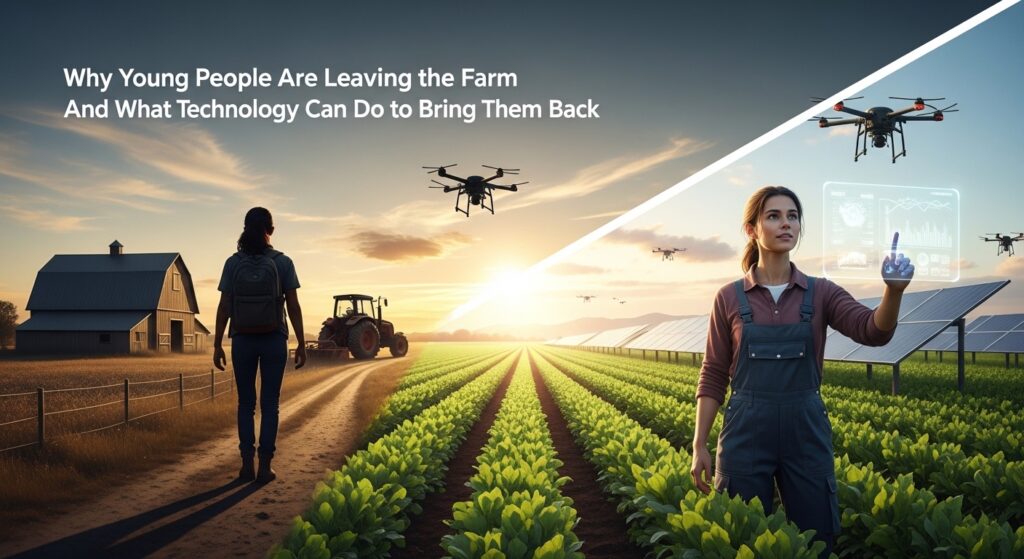
Agriculture has an image problem with the next generation, and technology is at the centre of it. Young people today are drawn to fields where intelligence is rewarded, where systems improve over time, where data informs decisions, and where a single person can have meaningful impact using the right tools. They see this in software, in logistics, in renewable energy, in health innovation. They do not yet see it widely in farming, not because farming is incapable of this transformation, but because the transformation has been slow to reach the farms that need it most. When a young person imagines becoming a farmer, they imagine rising before dawn to do the same tasks their grandparents did, in the same way, with the same limitations. That image is outdated. But it persists, and it pushes talented people away from one of the most important industries on earth.Technology Changes the Story
What happens when that image changes? When farming becomes an environment where a smartphone tells you what your soil needs before you walk the field. Where sensors alert you to a problem at two in the afternoon instead of you discovering it two weeks too late. Where irrigation runs on schedule without requiring someone to stand in the sun and manage it manually. Where records are clean, patterns are visible, and decisions are backed by data. Suddenly farming looks different. It looks like a place where intelligence matters. Where a young person who understands technology can genuinely build something, improve something, and measure the results. This is not a fantasy. It is the direction agriculture is moving. And the farms that adopt this direction earliest will also be the ones that attract a new generation of farmers. Technology does not eliminate the skill and knowledge that experienced farmers carry. It gives that knowledge a better platform. It reduces the purely physical burden and increases the space for thinking, planning, and improving. That balance is exactly what younger generations are looking for in meaningful work.A New Kind of Farmer
The farmers of the next decade will not look exactly like the farmers of the last one. They will manage more land with fewer people, supported by tools that monitor, alert, and recommend. They will make decisions using real data from their own fields, not just inherited wisdom. They will spend less time reacting to emergencies and more time building a farm that runs efficiently. This does not mean farming becomes easy. It will make you smarter. There is still knowledge to develop, still seasons to read, still moments that require experience and judgment that no machine can replicate. But the work is more interesting, more measurable, and more connected to the wider world. That is a version of farming that young people can see themselves in.The Future Needs Them
Agriculture cannot solve its labour shortage without the next generation. There are simply not enough experienced farmers to meet the growing demand for food, and the ones currently working are getting older. But the answer is not to convince young people to accept the same conditions that have been pushing them away. The answer is to change those conditions to make farming genuinely smarter, more efficient, and more rewarding as a profession. Technology is the bridge between where agriculture is today and where it needs to be. It will not solve everything overnight. But every farm that begins its digital journey is a farm that becomes a little more ready for the future and a little more capable of attracting the people who will grow that future. At Agrosenix, we believe this shift is not just possible. It is necessary. And it starts with building the right foundation. Agrosenix Bring Automation in Agriculture.Frequently Asked Questions
Why are young people leaving farming?
Many young people leave farming because it is physically demanding, unpredictable, and isolated. Cities often offer better income, comfort, and opportunities for personal growth.
Is farming not profitable for the next generation?
Traditional farming can be unpredictable, with income affected by weather, pests, and market fluctuations. This financial uncertainty discourages many young people from staying.
Can technology make farming more appealing to young people?
Yes. Smart tools, sensors, and automated systems reduce physical labor, provide real-time data, and make decision-making easier, creating a modern, tech-driven farming experience.
What kind of technology is helping modern farms?
Precision agriculture, farm automation, smart irrigation systems, and mobile apps for monitoring crops and livestock are among the technologies transforming farms.
Will technology replace farmers?
No. Technology enhances human expertise. It reduces repetitive tasks, improves efficiency, and allows farmers to focus on planning, decision-making, and optimizing their farms.
How can young people get involved in agriculture today?
Young people can start by learning about AgTech solutions, joining modern farming programs, experimenting with small tech-enabled plots, or connecting with organizations like Agrosenix that promote smart farming.
Why is it important to attract young people back to farming?
The current farming population is aging, and global food demand is rising. Attracting a new generation ensures sustainability, innovation, and continued productivity in agriculture.