The Cost of Not Knowing
There’s a type of loss in farming that rarely gets attention. It is not caused by drought, pests, or a bad harvest. It is the silent loss that happens earlier, in that brief gap between when something starts going wrong and when the farmer finally sees the signs.
Do you really think crops fall suddenly?. They fail gradually. Soil moisture drops below the threshold a plant needs, and stress begins before any visible symptom appears. A section of a field develops a drainage problem, and roots begin to suffer weeks before the leaves show it. Temperatures shift overnight in ways that create vulnerability in plants that look healthy at sunrise. On a traditional farm, the earliest signal available to a farmer is what they can observe with their own eyes and by the time something is visible, the damage is already underway. The window for the least costly response has already closed.
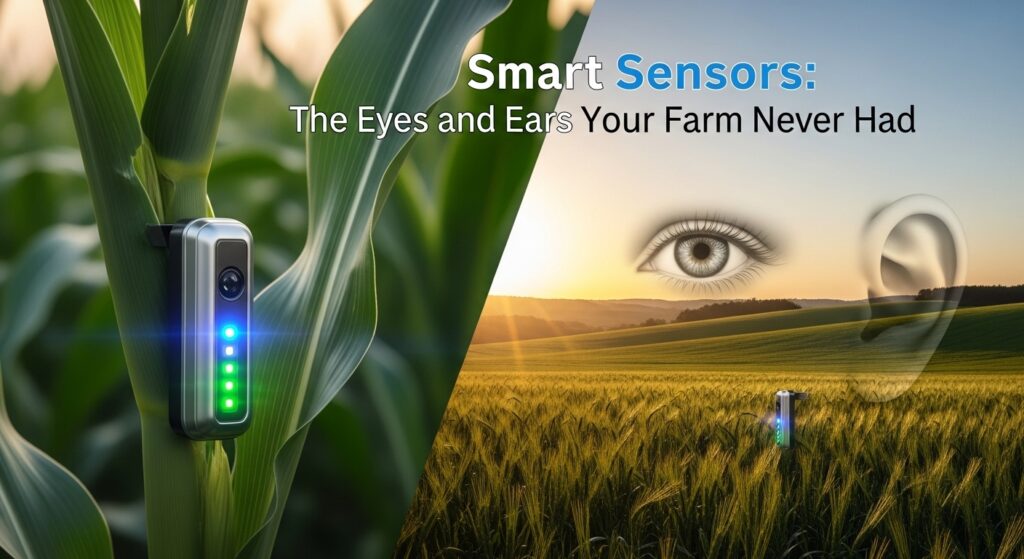
Smart sensors exist to close that gap. They are the eyes and ears that stay in the field continuously, watching for the changes that matter before they become problems that are difficult to reverse.
What a Sensor Actually Does
A sensor, at its core, is a device that measures something and reports it. In an agricultural context, that means measuring conditions in the soil, the air, or on the plant itself and making that information available without anyone needing to be physically present to collect it.
Soil moisture sensors, for example, sit beneath the surface and continuously track water levels at the root zone. They do not wait for a farmer to visit and press a hand into the dirt. They measure, they record, and when the data crosses a threshold, they can trigger an alert or, in more advanced setups, activate an irrigation response automatically. Temperature and humidity sensors track the microclimate of a field. They can detect the conditions that favour fungal disease or insect pressure, often hours before a human observer would notice any visible change.
Light sensors can monitor canopy conditions that affect growth rates. Leaf wetness sensors can track the duration of moisture on plant surfaces and are a key driver of many disease cycles that would otherwise be invisible. Individually, each sensor answers a specific question. Together, they begin to answer a much larger one: what is actually happening on this farm right now?
Soil, Water, and the Work of Watching
The two areas where sensors deliver the most immediate impact for most farms are soil monitoring and water management. Water is agriculture’s most managed resource and its most wasted one. Irrigation based on schedules or rough observation tends to apply either too much or too little and the consequences are always costly. Too much water leads to runoff, nutrient loss, and root damage. Too little leads to stress that reduces yield even when no visible symptoms appear.
A soil moisture sensor removes the guesswork. It tells the system, and the farmer, exactly how much water is available at the root level, and whether an irrigation event is actually necessary. Farms that move from schedule-based irrigation to sensor-guided irrigation consistently find they use less water while producing healthier crops. The improvement is not because they tried harder but it is because they finally had accurate information.
Soil monitoring goes beyond moisture. Sensors can track temperature at different depths, which matters significantly for seed germination, root development, and the timing of planting. They can track organic matter content over time, giving farmers a long-view perspective on soil health that seasonal observation alone could never provide. This continuous, ground-level visibility transforms how a farmer understands their land. Not as a field that looks a certain way when you walk through it, but as a living system whose internal state can be known, tracked, and responded to.
From Individual Sensors to a Connected Farm
The real power of sensor technology does not come from any single device. It comes from integration. When sensors in different parts of a field feed into a shared platform, patterns emerge that would never be visible from any single data point. A section of a field that consistently shows lower moisture retention can be identified, explained, and managed differently. A correlation between temperature spikes and subsequent pest pressure can be observed over multiple seasons and used to anticipate future risk.
When sensor data is connected to farm activity records what was planted, when, what inputs were applied, what the yield was, the resulting picture is remarkably detailed. It becomes possible to understand not just what happened, but why. And understanding why is what makes the next decision better than the last. This connected visibility is what transforms a collection of instruments into an intelligent farm management system. It is the difference between measuring and knowing.
Accessibility Is Catching Up
For many years, agricultural sensors were associated with large commercial farms and high capital investment. The cost of hardware, installation, and data management put them out of reach for smallholder and medium-sized farms.
That is changing. The cost of sensor hardware has fallen significantly. Connectivity options in rural areas are expanding. And platforms that integrate sensor data with farm management tools are being built specifically for farms that do not have large technical teams or infrastructure budgets. The entry point is no longer out of reach. And the starting point does not have to be a fully connected, sensor-rich system. A single soil moisture sensor in a critical field, integrated with a management platform that already tracks other farm data, can deliver immediate and measurable value. From there, a farm can grow its sensor network progressively, adding capacity where it is most needed, building toward a level of visibility that was once available only to the largest operations in the world.
Sensing the Future
Agriculture’s labour problem is, in part, an information problem. Tasks that require constant human presence, checking moisture levels, monitoring crop health, watching for early signs of stress or disease have consumed enormous amounts of time and effort precisely because there was no other way to know what was happening. Sensors change that equation. They do not replace the farmer’s judgment. They give that judgment something accurate and continuous to work with, instead of the incomplete, delayed snapshots that physical observation alone can provide.
At Agrosenix, our vision for automation is built on exactly this principle. Before a farm can act automatically, it must first be able to sense intelligently. The sensor is where that journey begins.The field is already telling you what it needs. The question is whether you are equipped to hear it.
Ready to stop guessing and start knowing what’s happening in your field? Download Agrosenix and monitor soil moisture, temperature, and crop conditions in real time. Built for farmers who want smarter decisions, not surprises.
Agrosenix Bring Automation in Agriculture.