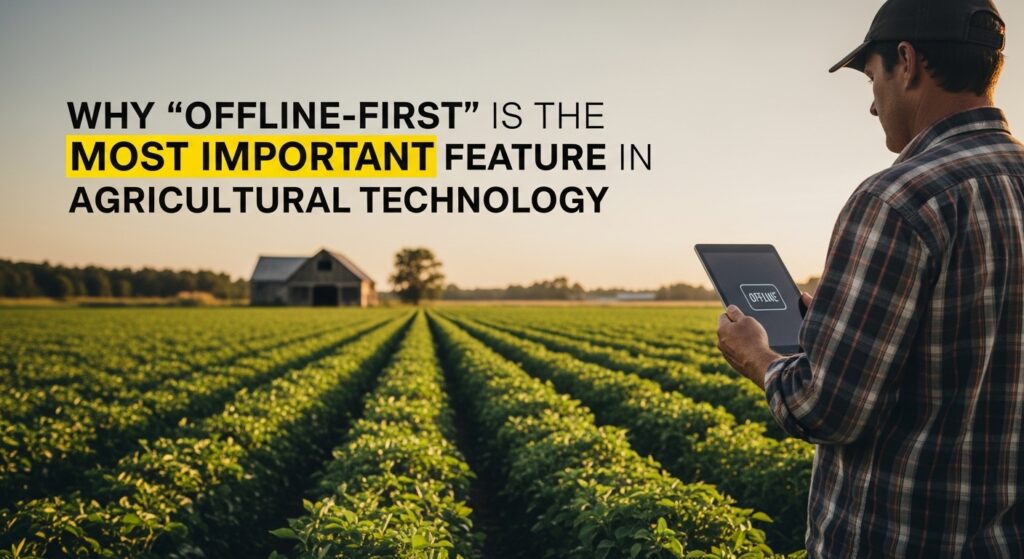
If your farm management app stops working when you lose internet signal, it’s not a farm app, it’s a toy. Let’s talk about the elephant in the field that most agricultural technology companies ignore: rural internet connectivity is terrible, and it’s not getting better anytime soon.
Yet somehow, most farm management apps are built as if every farmer has high-speed fiber optic internet reaching every corner of their land. They’re designed for Silicon Valley offices, not actual farms. This is why “offline-first” technology isn’t just a nice feature for farm apps, it’s the foundational requirement that determines whether a tool is actually usable or completely worthless.
The Rural Connectivity Reality
Let’s be honest about what the internet looks like on most farms worldwide. In developed countries, you might have decent connectivity at your farmhouse, but walk just 500 meters into your fields and you’ll have two bars if you’re lucky. Drive to the back forty and you’ll have no signal at all. Try working in a barn or greenhouse and you’ll find yourself in a dead zone with no connectivity whatsoever. The situation in developing regions is even more challenging. Many rural areas have only 2G coverage at best, if that. Data costs are prohibitively expensive. Signals come and go unpredictably throughout the day. Some areas have no coverage at all.
Several universal truths apply everywhere. The Internet is weakest precisely where you do most of your farm work, in the fields, away from buildings. Weather affects signal strength dramatically, and ironically, storms that threaten your crops also knock out your connectivity right when you need information most. Rural infrastructure investment lags decades behind urban areas, with no indication that will change soon. Even the “good” rural internet available in some locations remains inconsistent and unreliable by urban standards. This isn’t a temporary problem waiting for 5G to solve everything. This is the permanent reality of farming in remote locations where population density doesn’t justify massive infrastructure investment.
Why Most Farm Apps Fail Farmers
Consider what happens when you try to use a conventional farm management app on a real farm. In the morning, you open the app at breakfast with home WiFi and plan your day, everything works great. But by mid-morning, you’re out in the field and want to record that you’ve started applying fertilizer. You open the app and see: “No internet connection. Please connect to WiFi to continue.” The app is suddenly useless, so you make a mental note to record it later and hope you remember. By afternoon, you discover signs of pest damage in a field. You want to check your app’s recommendation about how to handle it. You pull out your phone but there’s no signal. You can’t access anything the app would tell you, so you’re on your own to figure out what to do.
When you finally get back home in the evening, you’re exhausted. You remember you were supposed to record that fertilizer application from this morning. Was it 8 bags or 9? Which field was that anyway? You guess, enter approximate data, and realize you’ve undermined the entire value of tracking. A week later, you realize you forgot to record several other important activities too. Your data is incomplete, your records are inaccurate, and the app is basically worthless for making actual farming decisions.
This is why conventional farm apps have such terrible retention rates among farmers. It’s not because farmers don’t want the features, it’s because the apps literally don’t work in actual farming conditions where connectivity is unavailable.
What “Offline-First” Actually Means
“Offline-first” isn’t just about “working without internet sometimes.” It’s a fundamentally different approach to building technology from the ground up. Traditional apps are built online-first: they assume you’ll have constant internet connectivity, store all data on remote servers, break completely when the connection drops, require internet for every single action, and treat syncing as an afterthought that’s often buggy and unreliable.
Offline-first apps flip this entire model. They assume that the internet is unreliable or absent, store all data locally on your device as the primary storage, work perfectly without any internet whatsoever, sync automatically whenever connectivity appears, and treat online connectivity as a bonus feature rather than a requirement for basic functionality.
With a true offline-first app like Agrosenix, you get a completely different experience. When you’re in the field with no signal, you can record expenses and purchases just as easily as if you were sitting at home with perfect WiFi. You can track crop activities and farm operations, log pest observations and weather notes, access all your historical farm data instantly, get AI recommendations based on your local data, view financial reports and insights, and plan upcoming activities. Everything works exactly as if you had perfect internet connectivity, because the app doesn’t need the internet to function, it’s designed to run entirely on your device.
When you eventually get connectivity back, the magic happens invisibly. All your recorded data syncs automatically to the cloud. Updates and new features download silently. You get fresh weather forecasts and market prices. AI models update with the latest insights. Data backs up securely to protect against device loss. The app handles all of this in the background, working invisibly. You never think about “syncing” or “uploading” or “connecting”, it just works.
The Technical Magic That Makes It Possible
How do offline-first apps work when traditional apps can’t? Several clever technologies work together to make this possible.
The foundation is a local database where all your farm data lives on your phone in a sophisticated structure. Think of it as having your entire farm management system stored right on your device, no server required for basic functionality. This is what makes everything else possible.
A smart sync engine works behind the scenes. A specialized background service continuously watches for internet connectivity. The moment connectivity appears (even briefly), it intelligently syncs only what’s changed since the last sync, minimizing data usage and maximizing efficiency. This means even brief moments of connectivity keep your data synchronized.
Conflict resolution algorithms handle the complexity of distributed data. What if you edit data on your phone while someone else edits the same farm information on the web? Smart algorithms automatically resolve these conflicts, keeping everyone’s data consistent and preventing the loss of information.
Progressive web app architecture uses modern web technology that works like a native app, stores data locally, and runs offline seamlessly. This gives you one unified app that works everywhere—on your phone, tablet, or computer, with or without the internet.
Finally, on-device AI makes intelligence available right where you need it. Critical AI features like crop recommendations and pest alerts can run directly on your phone using lightweight machine learning models, requiring no cloud processing or internet connection to provide insights.
Real-World Benefits of Offline-First
Record Data When and Where It Happens The traditional problem is that by the time you get home and have internet, you’ve forgotten details or lost the motivation to record them, resulting in missing or inaccurate data. With offline-first technology, you simply pull out your phone in the field, record the activity immediately while all the details are fresh in your mind, and continue working. Your data gets captured accurately at the moment it matters most, before details fade or get mixed up with other activities.
Make Decisions in Real-Time A major limitation of connectivity-dependent apps is that when you need information NOW to make a farming decision, you can’t access your app without internet connectivity. With offline-first, all your historical data, financial reports, and AI recommendations are instantly available even in the most remote corner of your field. You can make informed decisions on the spot, without delays or guesswork.
Never Lose Work Online-dependent apps have a frustrating problem: the connection drops mid-task and you lose everything you were entering. Frustration builds quickly and you eventually stop using the app entirely. Offline-first solves this completely. Every keystroke is saved locally immediately, regardless of connection status. You literally cannot lose work due to connectivity issues, no matter how unreliable your signal is.
Minimize Data Costs Constantly streaming data to and from cloud servers burns through expensive mobile data plans, which is especially painful in regions where data costs are high. With offline-first architecture, most of your work happens locally with zero data usage. Syncing only happens when you’re on WiFi (if you prefer) or uses minimal data when on a mobile connection, protecting your data budget.
Privacy and Security The traditional approach where all your sensitive farm data constantly travels over the internet creates significant security and privacy risks. Offline-first keeps your data on your device primarily, encrypted and secure locally. When syncing does occur, it uses encrypted connections. You maintain complete control over your information.
Reliability in Extreme Conditions: Storms, power outages, and rural infrastructure issues frequently disrupt connectivity at exactly the moment when you need information most—like during a pest outbreak. Your offline-first app works identically whether you have perfect 5G connectivity or zero signal. Weather doesn’t affect functionality at all.
Case Study: How Offline-First Changed Everything for Real Farmers
James, Kenya: “Before Agrosenix, I tried three different farm apps. All required internet. I’d start entering data, lose signal, lose everything. I gave up on all of them. Agrosenix works everywhere on my farm, I finally have accurate records for the first time in 15 years of farming.”
Maria, Brazil: “My farm is in a valley with spotty coverage. Conventional apps were completely useless. With Agrosenix’s offline capability, I can track everything during the day, and it all syncs automatically when I get home. It’s exactly what I needed.”
Rajesh, India: “Data costs are expensive here. Apps that constantly need internet connection drain data and battery. Agrosenix uses almost no data because everything works offline. I can actually afford to use it daily.”
Chen, Vietnam: “During monsoon season, the internet is unreliable for weeks. Old apps became unusable exactly when I needed them most. Agrosenix works perfectly whether or not I have a signal. It’s changed how I manage my farm during critical periods.”
Why Don’t More Apps Work Offline?
If offline-first is so important for farming, why don’t all farm apps work this way? There are several reasons. It’s technically harder, building offline-first requires much more sophisticated engineering than building traditional cloud-dependent apps, which is why many developers avoid it. It’s more expensive too. Developing robust sync systems, conflict resolution algorithms, and local data management costs more upfront, and many companies cut corners on features they see as secondary.
Many app developers simply don’t understand farming. Silicon Valley engineers build apps in comfortable offices with gigabit internet connectivity. They just don’t appreciate how terrible rural connectivity is or how critical offline functionality is for farming realities. What seems like an edge case to them is actually the core use case for farmers. Legacy systems add to the problem. Older farm management systems were built when offline technology wasn’t as feasible. Rebuilding them from scratch with offline-first architecture is expensive and difficult, so companies stick with what they have.
At Agrosenix, we started from scratch with offline-first as our core principle rather than an afterthought. Every feature is designed to work perfectly without the internet, because we understand that offline functionality is the reality of actual farming in the world.
The Future is Offline-First
As agricultural technology evolves, the gap is widening between offline-first apps (which farmers actually use consistently) and traditional online-dependent apps (which farmers install, try once, and then abandon in frustration). This trend will only accelerate as farmers become more sophisticated about their technology needs.
Smart agricultural technology companies are already recognizing this reality. New apps launching today are being built with offline-first architecture from the start, because their founders understand farming. Legacy providers are struggling to retrofit offline capabilities into their systems, discovering it’s far harder to add offline functionality to online-dependent architecture than to build offline-first from the beginning. Most tellingly, farmers are increasingly demanding offline functionality as a baseline requirement rather than a nice-to-have feature.
The market is clearly signaling that “works offline” is moving from being a “nice bonus feature” to an “absolute requirement” for any farm app worth using. If you’re evaluating farm management tools and offline functionality isn’t front and center in their marketing, that tells you everything you need to know about whether they truly understand actual farming conditions.
Questions to Ask Any Farm App
Before committing to a farm management app, ask these critical questions to determine if it’s truly offline-first. First, ask if it works completely offline, or if it just caches some data. Complete offline functionality matters, partial offline capability won’t cut it. Second, confirm that you can record new data without any internet connection. This is the fundamental test of true offline-first functionality.
Third, check if you can access your full historical farm data while offline. If you can’t see your past records and data, it’s not truly offline-first no matter what they claim. Fourth, verify that you get recommendations and insights while offline. AI should work locally on your device, not require cloud processing to provide value.
Fifth, ask what happens when you edit data offline on multiple devices. Robust conflict resolution is absolutely essential for true offline-first apps. Finally, find out how much data the syncing process consumes. It should be minimal, efficient sync is actually a core part of what makes offline-first technology work properly.
If the app can’t answer “yes” to all six of these questions, it’s not truly offline-first, and you’ll likely face frustration trying to use it in real farming conditions.
Experience the Difference with Agrosenix
Agrosenix was built offline-first from day one because we understand that rural connectivity is the reality for most farmers, not an edge case to work around. This design philosophy affects every aspect of how the app functions.
Every feature works perfectly without any internet connection whatsoever. You can record all farm activities and expenses as if you had perfect connectivity. You can access your complete farm history and financial data instantly. You get AI-powered crop recommendations based on local data. You can view reports and insights. You can plan future activities. You can even connect with community cached content that works offline. When you do get connectivity eventually, the benefits accumulate. Automatic background sync happens invisibly without you needing to think about it. Syncing uses minimal data through efficient sync algorithms. You get fresh weather updates and market prices. New content and features download. Your data backs up securely to the cloud.
Here’s a simple test to understand what offline-first really means: Download Agrosenix, set up your farm, record some activities, then turn your phone on airplane mode. The app works identically to how it worked before you lost connectivity. That’s what true offline-first means, the connection status is irrelevant to core functionality.
The Bottom Line
This table compares farm management apps: those that require the internet, those with limited offline features, and fully offline professional tools built for real farmers.
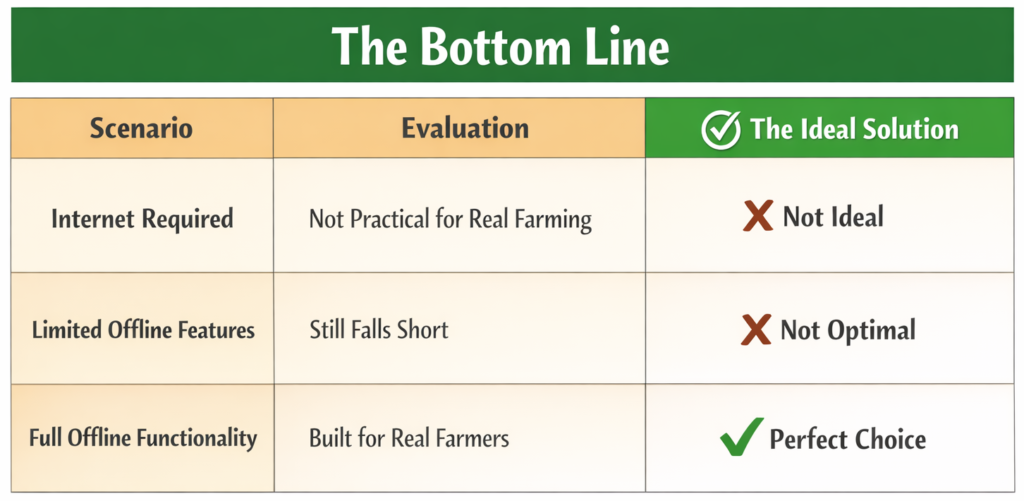
Agrosenix is that tool.
We’re not promising offline as a feature, we’re built offline-first as our foundation. It’s why farmers who’ve tried multiple farm apps consistently say Agrosenix is the first one they actually kept using.
Download Agrosenix today and discover what farm management feels like when internet connectivity is irrelevant.
Your farming doesn’t stop when the signal drops. Your farm management app shouldn’t either.
Ready for farm management that works everywhere? Download the Agrosenix beta app, truly offline-first technology designed for real farming conditions. Free during beta. Works offline. Built by people who understand farming.