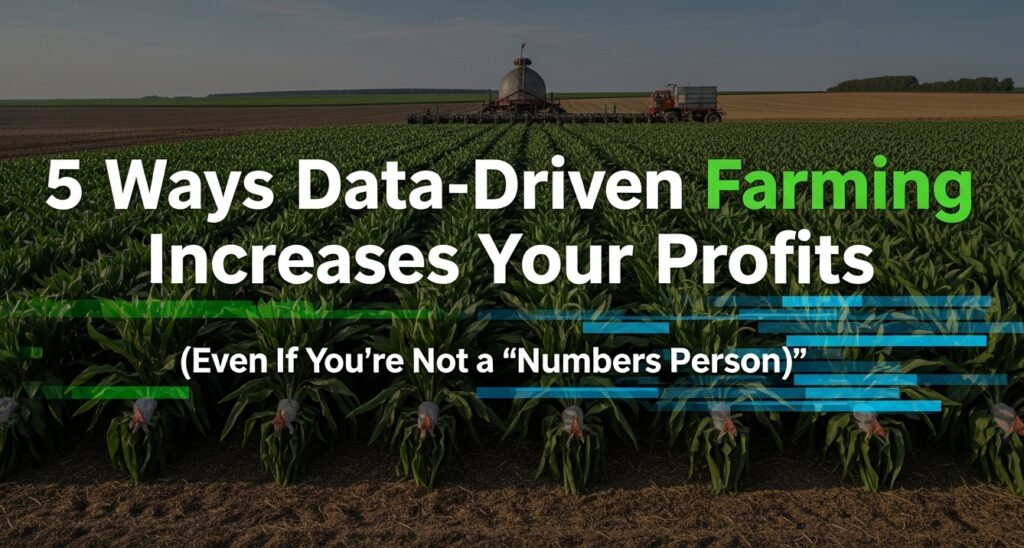
You don’t need to be an accountant or data scientist to make more money from your farm. You just need to start tracking the right things. Most farmers work incredibly hard but struggle to increase profitability. Why? Because farming without data is like driving with your eyes closed, you might move forward, but you have no idea if you’re heading in the right direction.
The good news: small changes in how you track and use data can lead to significant profit improvements. Here’s how.
The Profit Problem Most Farmers Face
Ask a farmer how their season went, and you’ll typically hear variations on the same theme: “It was okay” or “Could have been better” or “We worked hard.” These vague answers reflect a deeper problem. When you ask specific questions, which crop was most profitable per hectare? What was your return on investment for each input type? Where did most of your money actually go? Which activities consumed the most time versus revenue generated? The answers become even more vague. Most farmers simply don’t have this data, so they can’t make informed decisions about where to invest time and money.
This isn’t because farmers aren’t smart, it’s because tracking this information manually is nearly impossible while actually farming. So decisions get made based on tradition, gut feeling, or what neighbors are doing, rather than what the data actually says about your specific farm.
Why Data Matters for Farm Profitability
Here’s a truth that transformed thousands of farms: You can’t optimize what you don’t measure. Data reveals patterns you’d never notice otherwise. The crop you think is your best moneymaker might actually be breaking even when you account for all costs. Small input purchases that seem insignificant add up to thousands per season. Labor costs might be eating into profits far more than you realize. Your most profitable field might not be the one with the highest yield. Once you see these patterns clearly, you can make strategic changes that actually move the needle. Even small optimizations, 5% less waste here, 10% better timing there, compound into significant profit improvements that transform your bottom line.
Let’s look at five specific ways data increases your bottom line.
1. Identify Your True Profit Centers
Not all crops are equally profitable, but farmers often allocate resources based on tradition or convenience rather than profitability. The data solution is straightforward: track total costs (seeds, fertilizer, pesticides, labor, water, equipment) and total revenue for each crop separately. When you do this, you’ll discover things that surprise you. Your highest-yielding crop might not be your most profitable after accounting for all those input costs. Crops with lower yields but much lower input costs often deliver much better margins. Some crops consistently deliver strong returns while others barely break even or even lose money.
Armed with this knowledge, you can take strategic action. Shift more land and resources to your genuinely profitable crops. If a crop isn’t delivering adequate returns and can’t be improved, consider replacing it with alternatives that make better financial sense. Consider a real example: a farmer in Kenya tracked his data for one season and discovered his maize (which he considered his main crop) had a profit margin of only 8%, while his beans (which he grew as a sideline) had a 35% margin. The next season, he doubled his bean acreage and increased overall farm profitability by 40%.
2. Eliminate Hidden Cost Leaks
Small, frequent expenses fly under the radar but collectively drain significant money from your farm. The solution is to religiously track every single expense, no matter how small, categorized by type (seeds, fertilizer, pesticides, fuel, labor, repairs, etc.). When you do this religiously, you’ll make discoveries about where your money actually goes, and it’s often surprising. You’ll see which expense categories are growing unsustainably, identify opportunities to buy in bulk, negotiate better prices, or find alternatives. You’ll notice waste patterns, like buying more inputs than you actually use.
Once you can see your top expense categories clearly, you can strategically reduce costs in targeted ways. You might negotiate with suppliers, buy cooperatively with other farmers, eliminate unnecessary purchases, or find cheaper alternatives that deliver similar results. Consider a real example: a farmer in India started tracking all expenses digitally and discovered he was spending 18% of his budget on diesel fuel, much higher than he had realized. He invested in a more efficient irrigation system that paid for itself in fuel savings within just two seasons, a return on investment that wouldn’t have been obvious without the data.
3. Optimize Input Timing and Usage
Applying too much fertilizer wastes money without improving yields. Applying too little reduces productivity. Timing inputs poorly reduces their effectiveness and wastes resources. The solution is to track exactly when and how much of each input you apply, then correlate this data with yield results and weather data. When you do this, you’ll discover the optimal application rates for your specific soil and conditions. You’ll identify which inputs deliver the best return on investment, and how weather timing affects input effectiveness. Most importantly, you’ll see whether you’re over-applying (wasting money) or under-applying (sacrificing yield).
With this knowledge, you can fine-tune your input strategy based on what actually works on your farm, not generic recommendations from textbooks. Reduce over-application where it doesn’t improve yields. Increase strategic applications where data shows strong ROI. A Brazilian farmer tracked fertilizer applications and yields for three seasons and made a revealing discovery: splitting nitrogen applications into three smaller doses during key growth stages increased yields 12% more than one large application, using the same total amount of fertilizer. Better results with no additional cost, that’s the power of data-driven timing.
4. Make Better Planting and Crop Rotation Decisions
Crop selection and rotation decisions are often based on “what we’ve always done” rather than strategic analysis of what actually works best. The data solution is to build a multi-season database showing which crops performed best in which conditions, how different rotations affected soil health and yields, and which combinations delivered optimal results. When you have this data, you’ll discover which crops are best suited to your specific microclimate and soil type. You’ll understand how different crop sequences affect the profitability of subsequent seasons. You’ll see whether pest and disease patterns are linked to specific crop rotations. You’ll identify which cover crops or rotation strategies deliver the best long-term results.
Armed with this knowledge, you can design a crop rotation strategy based on your historical data rather than theoretical advice. Plant more of what demonstrably works on your land. Experiment strategically with new crops on small plots, tracking results carefully before scaling up. A Vietnamese farmer tracked three years of data and discovered something valuable: rotating rice with vegetables increased rice yields by 15% in the following season due to soil health improvements, while the vegetables provided additional income. This rotation pattern became his standard, significantly improving his total farm profitability year after year.
5. Calculate True Return on Investment for Every Decision
Farmers often invest in inputs, equipment, or practices without knowing whether those investments actually pay off financially. The solution is to track the cost of every investment and measure its impact on yield or revenue, then calculate ROI to understand which investments are genuinely worth making. When you have this data, you’ll discover which inputs deliver strong returns and should be prioritized versus which provide only minimal benefit. You’ll see whether investing in quality seeds actually pays off compared to cheaper alternatives. You’ll understand if hiring additional labor during critical periods improves profitability. You’ll know whether that expensive equipment purchase was actually worth the money.
With this clarity, you can rank your potential investments by expected ROI based on your historical data. Prioritize high-ROI activities. Eliminate or reduce low-ROI practices. Make investment decisions confidently, knowing they’re backed by your own farm’s data rather than guesswork. A farmer in Tanzania was considering buying a mechanized planter, a significant expense that felt risky. By tracking data for one season, he realized that hand-planting delays were causing an average yield loss of 20% due to sub-optimal planting timing.
The improved timing from mechanized planting would easily justify the investment financially. With clear ROI data backing him up, he confidently bought the equipment and recouped his costs in just 18 months.
Getting Started with Data-Driven Farming
You don’t need fancy software or complicated systems to start benefiting from data. Getting started is straightforward if you follow a simple approach.
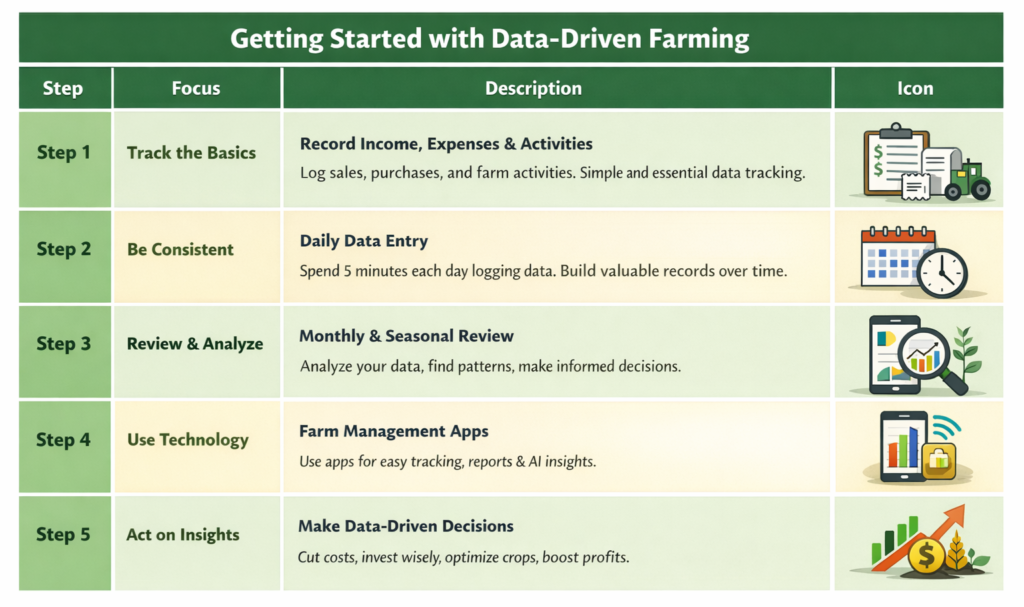
Step 1: Start Simple, Track the Basics Begin with three essential categories of information. Track your income by recording every sale, who bought it, how much they paid, and when the transaction occurred. Track your expenses by recording every purchase, what it was for, how much it cost, and when you made it. Track your activities by recording what you actually did, where you did it, when you did it, and what inputs were used. Don’t worry about being perfect. Even imperfect data is infinitely better than no data, and you can always refine your tracking as you go.
Step 2: Be Consistent The power of data comes from accumulation over time. One week of expense tracking tells you nothing meaningful. One full season of consistent tracking starts revealing patterns. Multiple seasons of data become incredibly valuable for spotting trends. Make data entry a daily habit, spend just 5 minutes each evening recording the day’s activities, expenses, and observations. This consistency is what transforms data from scattered numbers into actionable insights.
Step 3: Review and Analyze Data is useless if you never look at it. Set aside time monthly and at the end of each season to review what the numbers are telling you. Ask yourself questions like: Where did money go this month? Are we on track versus budget? What patterns am I noticing? What decisions should I make differently based on this data? This regular review transforms data into decision-making power.
Step 4: Use Technology to Make It Easy Modern farm management apps like Agrosenix make data tracking effortless rather than burdensome. You can record expenses with just a few taps instead of writing in a notebook. Track activities in the field even without internet connectivity. Get automatic calculations and reports without doing the math yourself. View visual charts showing trends and insights at a glance. Receive AI-powered recommendations based on your actual data. Technology eliminates the tedious parts of data management, letting you focus on farming while still capturing valuable information.
Step 5: Act on Your Insights Data without action is just numbers on a screen. The real profit comes from making better decisions based on what the data shows you. Cut costs in low-ROI areas. Invest more in high-ROI activities. Adjust your crop mix toward profitable options. Optimize your timing based on your historical patterns. Negotiate better with suppliers based on concrete usage data showing how much you actually need.
Common Objections (and Why They’re Wrong)
You might be thinking, “I don’t have time for data entry.” Here’s the reality: with a mobile app, data entry takes only 5-10 minutes per day, less time than you probably spend on coffee breaks or tea breaks. And the profit improvements from data-driven decisions will save you far more time and money than you invest in the tracking itself.
Another common concern is, “I’m not good with numbers.” You don’t need to be. Modern apps do all the calculations automatically. You just enter basic information, and the app tells you what it means through clear charts and reports.
Some people assume, “Data is for big farms, not small operations like mine.” Actually, small farms benefit MORE from data than large operations. Large farms have financial margins to absorb inefficiencies and mistakes. Small farms need every advantage to stay profitable, and data provides exactly that kind of competitive advantage.
Finally, farmers sometimes say, “I’ve farmed for 20 years without data just fine.” Here’s the thing: “just fine” is the enemy of “really profitable.” Beyond that, the farming world is changing. Costs are rising, weather is becoming less predictable, and competition is increasing. Data gives you the edge to not just survive, but to genuinely thrive in these changing conditions.
The Bottom Line
Farming is a business, and like any business, profit comes from making smart decisions. Smart decisions require information. Information comes from data. You’re already working hard. Data-driven farming ensures that your hard work translates into maximum profitability.
The farmers who thrive in the coming decade won’t be the ones who work the hardest (though hard work matters). They’ll be the farmers who combine hard work with smart decisions, decisions informed by data that reveals what actually works on their specific farm.
Start Your Data-Driven Farming Journey Today
Agrosenix makes data-driven farming accessible to every farmer, regardless of your education level or technical skills. With easy tracking, you can record expenses and activities in seconds, even without internet connectivity in the field. You get automatic analysis that provides profitability reports and insights without you having to do manual calculations. The system delivers AI recommendations that give you personalized advice based specifically on your farm’s unique data. Most importantly, you gain financial clarity so you can see exactly where money goes and which activities actually drive profit.
Download the Agrosenix beta app and start tracking today. By next season, you’ll have the insights necessary to make your farm significantly more profitable than it was before.
Your farm data is your competitive advantage. Start building it now.
Ready to increase your farm profitability through data-driven decisions? Download Agrosenix and start tracking today. Free during beta. Works offline. Built for farmers like you.